Gallery: AvianPosted January 8, 2014328 views13 comments
This afternoon, back yard
(ID corrected)
2014:01:07 11:41:15
D800
500mm
1/250 sec, f/4
Mode: Av
Metering: Spot
ISO: 640
AF mode: AF-C
White balance: AUTO1+2
Flash: Off
Hand-held
Comments
13 comments
Comment posted by Charlie VanTassel on January 8, 2014 at 12:32 AM
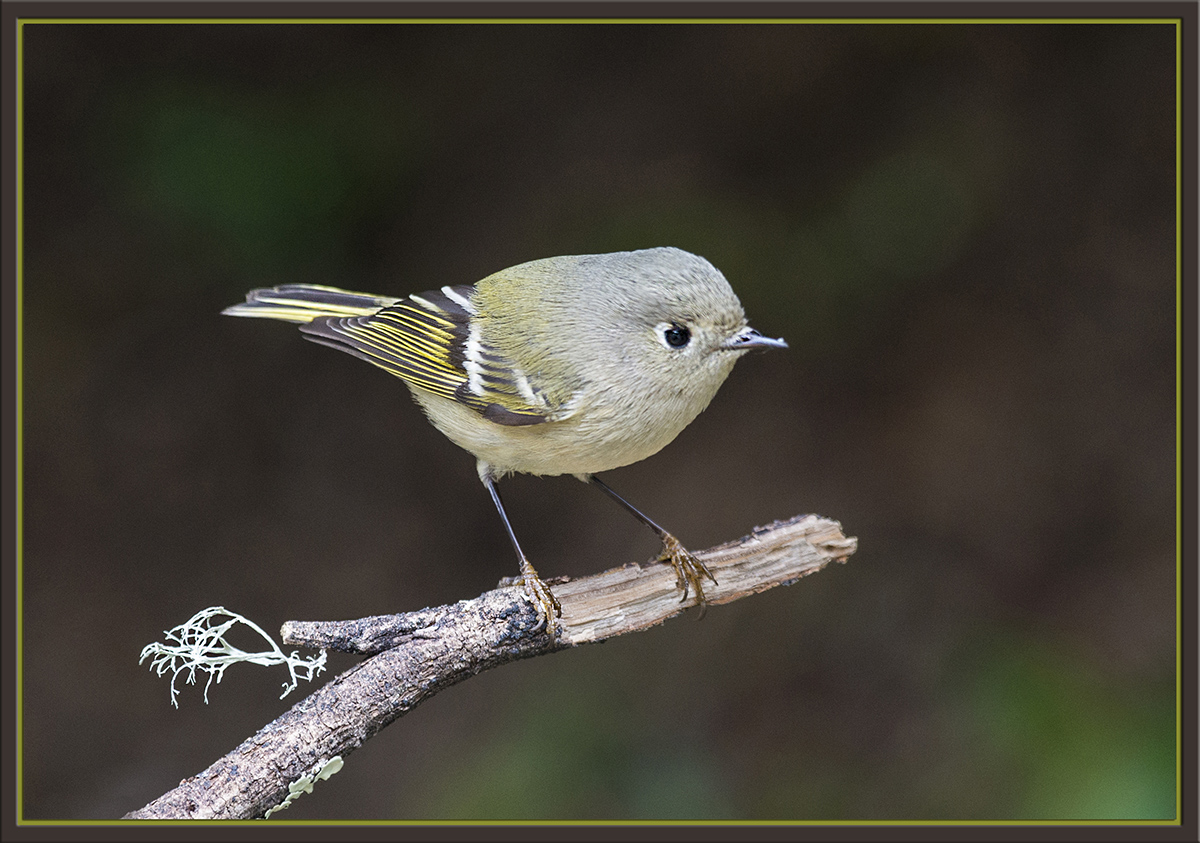
A beautiful pose, Sandy. This looks like a Ruby-crowned Kinglet to me..... nice techs too.
Registered on October 18, 2006, 644 Posts, 4801 Comments
Comment posted by SandyRichardsBrown on January 8, 2014 at 12:39 AM
Charlie, I thought it might be, but Sibley's says "feeds only on small insects" and "solitary"
This guy was among 5 others, and definitely eating seeds.
??
Sandy
Registered on November 24, 2003, 3937 Posts, 12909 Comments
Comment posted by Charlie VanTassel on January 8, 2014 at 12:54 AM
Cassin's Vireo is also an insect eater. I'm sure someone will straighten us both out any minute now....
Registered on October 18, 2006, 644 Posts, 4801 Comments
Comment posted by Hans Overduin on January 8, 2014 at 5:56 AM
Looks like a very small bird, nice job framing it ! Cheers, Hans
Registered on August 31, 2011, 491 Posts, 3807 Comments
Comment posted by Brian Gatlin on January 8, 2014 at 7:59 AM
it's a ruby-crowned kinglet (thin bill, vireo bills are thick; eye ring is thin and does not continue to form spectacles as on the vireo, wing pattern, etc). nice pose, and it's never easy to catch these guys, they are always in motion. the bird's head seems less sharp than the body. you might run some NR on the bg.
Registered on March 21, 2009, 202 Posts, 4187 Comments
Comment posted by John Neukirch on January 8, 2014 at 8:08 AM
Really a wonderful image of this little fellow.
Registered on July 9, 2012, 207 Posts, 1476 Comments
Comment posted by Dennis Plank on January 8, 2014 at 9:30 AM
Nice catch, Sandy. Excellent image. Yesterday was my weekly volunteer work day and one of the other guys was telling me that he'd had a bunch of these in his back yard the other day-acting quite atypically. One actually hopped up on his rake while he was watching them. This is in Olympia, WA. Maybe they're having an exceptional year.
Registered on January 28, 2008, 1767 Posts, 23192 Comments
Comment posted by Charlie VanTassel on January 8, 2014 at 10:17 AM
I guess you must have bugs in your seed.
Registered on October 18, 2006, 644 Posts, 4801 Comments
Comment posted by John Robinson on January 8, 2014 at 10:34 AM
Whatever it is - grand little fella ! Perch designed for the bird almost !
Cheers
JohnR
Registered on March 2, 2008, 535 Posts, 2453 Comments
Comment posted by Richard Ditch on January 8, 2014 at 10:46 AM
Definitely a Ruby-crowned Kinglet as Brian describes. Other points that separate kinglets from vireos:
- vireo legs and feet have a noticeable blue tinge to them; kinglets have black legs and yellow-orange feet
- vireo legs are scaled, while kinglet legs are smooth
Kinglets sometimes occur in large numbers in migration. One day at Sandy Hook in New Jersey we saw hundreds of them passing through - they were on every tree and shrub as well as on open stalks of grass.
Registered on November 1, 2003, 1031 Posts, 12705 Comments
Comment posted by SandyRichardsBrown on January 8, 2014 at 12:53 PM
Thanks to all for the clarification!
Sandy
Registered on November 24, 2003, 3937 Posts, 12909 Comments
Comment posted by Sharon Hallowell on January 8, 2014 at 8:09 PM
I really like your image of this kinglet. Nice detail, great perch and the dark green bg sets it off nicely. As a side note, Sandy...a couple of years ago we had a RC Kinglet at our feeders eating seed one winter. Wish it would come back! Sharon
Registered on November 1, 2003, 392 Posts, 4810 Comments
Comment posted by May Haga on January 9, 2014 at 5:05 PM
Very nice capture of this energetic little guy.
May
Registered on February 22, 2007, 714 Posts, 8470 Comments

Comments
13 commentsThis guy was among 5 others, and definitely eating seeds.
??
Sandy
Cheers
JohnR
- vireo legs and feet have a noticeable blue tinge to them; kinglets have black legs and yellow-orange feet
- vireo legs are scaled, while kinglet legs are smooth
Kinglets sometimes occur in large numbers in migration. One day at Sandy Hook in New Jersey we saw hundreds of them passing through - they were on every tree and shrub as well as on open stalks of grass.
Sandy
May