How The Sky Looked (Eclipse)
by Paul DeCesare
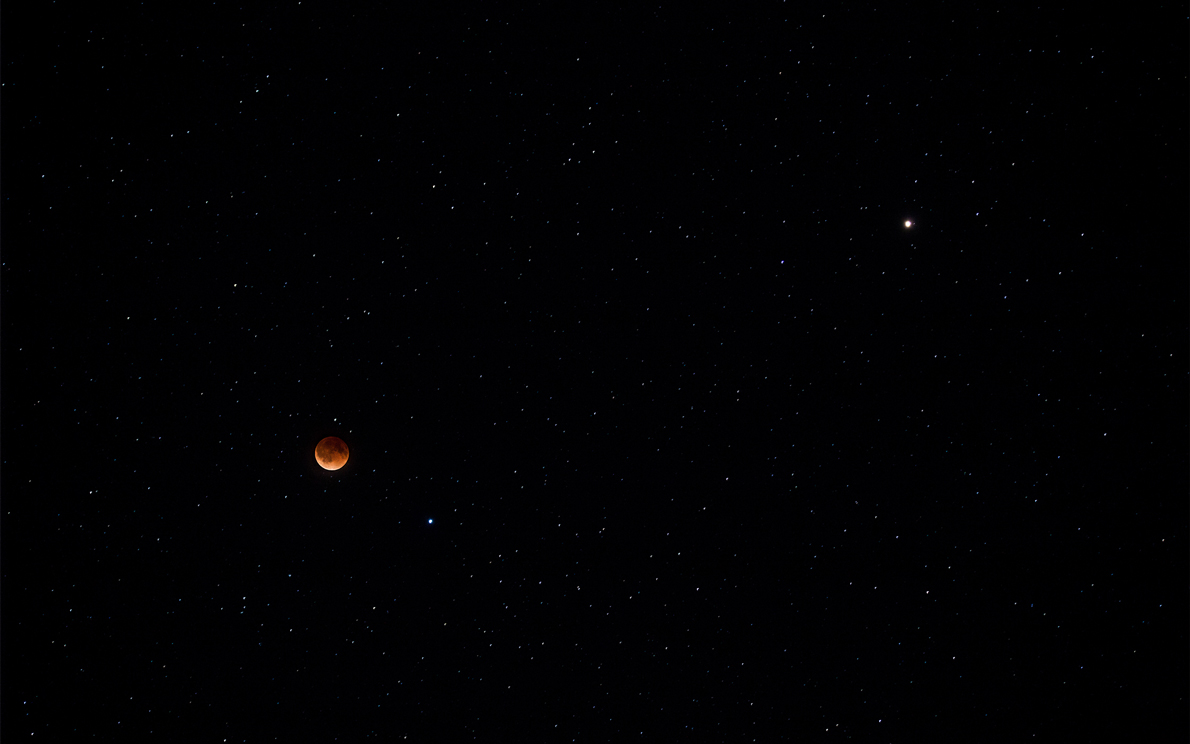
I do have 3 hours' worth of close eclipse images from Monday night that I shot for a research need, but this image is one that I carefully "processed" to show what the sky looked like out there that night.
PLEASE view it larger!
I drove up to Lowell Observatory in Flagstaff and planted myself in this circular pulloff right at the end of the short road that leads to the telescopes, so I knew I was in a good spot, 7,000 feet and zero light pollution. Once the moon was in full eclipse it was a full 8 stops lower in luminance which allowed all of the stars to come out like there was no moon that night. It was quite surreal to see, so I wanted to pull back and try to recreate a section as it was that night. This dual-exposure image is about as close as I can get, although the moon was probably a bit dimmer than this backlit version you are viewing.
I shot this at 115mm (on a FF sensor), the sky at 4.0 sec, f/2.8, ISO 2500, and then the moon shot at1/4 sec, f4.5, ISO 400. Both were at daylight WB although I feel the larger images of the moon I got with a 300mm lens look most accurate at 4200K. A simple mask in Photoshop revealed the properly exposed moon versus the heavens. I think I pushed it shooting 4.0 seconds at 115mm, the star trails are beginning to form, but I was at end-of-limit for decent low-noise and proper exposure.
BTW, The brightest object in the TR corner is Mars. And the brightest star and the 4 o'clock position near the moon is Spica, which you can see in Keith Bauer's excellent multi-exposure in this gallery.

Comments
6 commentsGreat work!
Sandy
Thank you for confirming that!
And I appreciate the comments from everyone. It's hard not to post the big frame-filling moon but I wanted to take a little risk.