Haunted
by Thomas Haney
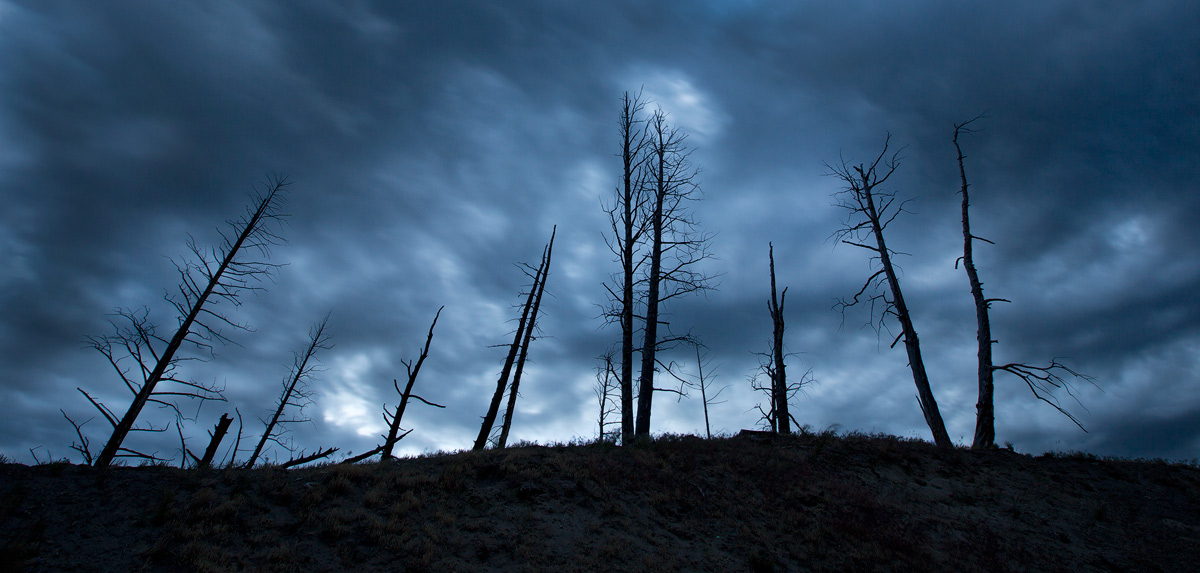
Saturday evening was one of those rare times when the clouds and sky are so amazing that it's difficult to decide what to point the camera at. After some incredible light at sunset I was driving out of the park and passed this hill above me to my right, and the quality of the light over the dead snags was too good to pass up.
I think these are snags left over from the 1988 fires, when about 40 percent of the park burned up, and it's interesting to go from one side of the park to the other and see how differently the landscape was affected in different areas. In some places the Lodgepole Pine, which need fire to reproduce, and coming back as thick as could be, while other areas of the park are still barren. Having been a wild land firefighter for 7 years now I should know why, but the only explanation I can think of is that the intensity of the fire in some areas was enough to kill everything, even the seeds on the ground or in the cones.
If anyone comes through West Yellowstone feel free to stop by the Smokejumping base and I'll give you a tour, we're just a half mile or so from the airport.
Canon 5d Mark iii, 16-35mm lens, 1.5 seconds at f/8, ISO 250, Gitzo Tripod

Comments
9 commentsWhen a forest fails to regenerate after a fire, several factors come into play...
A. Fire intensity: A really hot fire kills not only seeds, but kills soil bacteria and nutrients, as well as removing moisture and oxygen. Also, a crust can form that prevents water from percolating and oxygen to diffuse into the soil.
B. Lack of wildlife: If a forest burns with very high intensity, wildlife, especially birds, won't be there to transport seeds to the area.
C. Erosion: After a fire, the soil is very fragile and highly susceptible to erosion by wind or water.
D. Micro climate: Slight variations in temperature, humidity, dew point and precipitation due to aspect and topography will also have an effect on regeneration.
Here in Tuolumne County, CA we're dealing with these issues caused by last year's monstrous Rim Fire. It will interesting to see how the forests recover, or don't recover.
Nice image, Thomas.
--P
Anyhow, when I was walking through the most barren, lifeless snag patch I've seen in yellowstone recently, a big black bear came ambling through, stopping often to dig something out of the ground.