Old Paria [+junk]
by John Williams
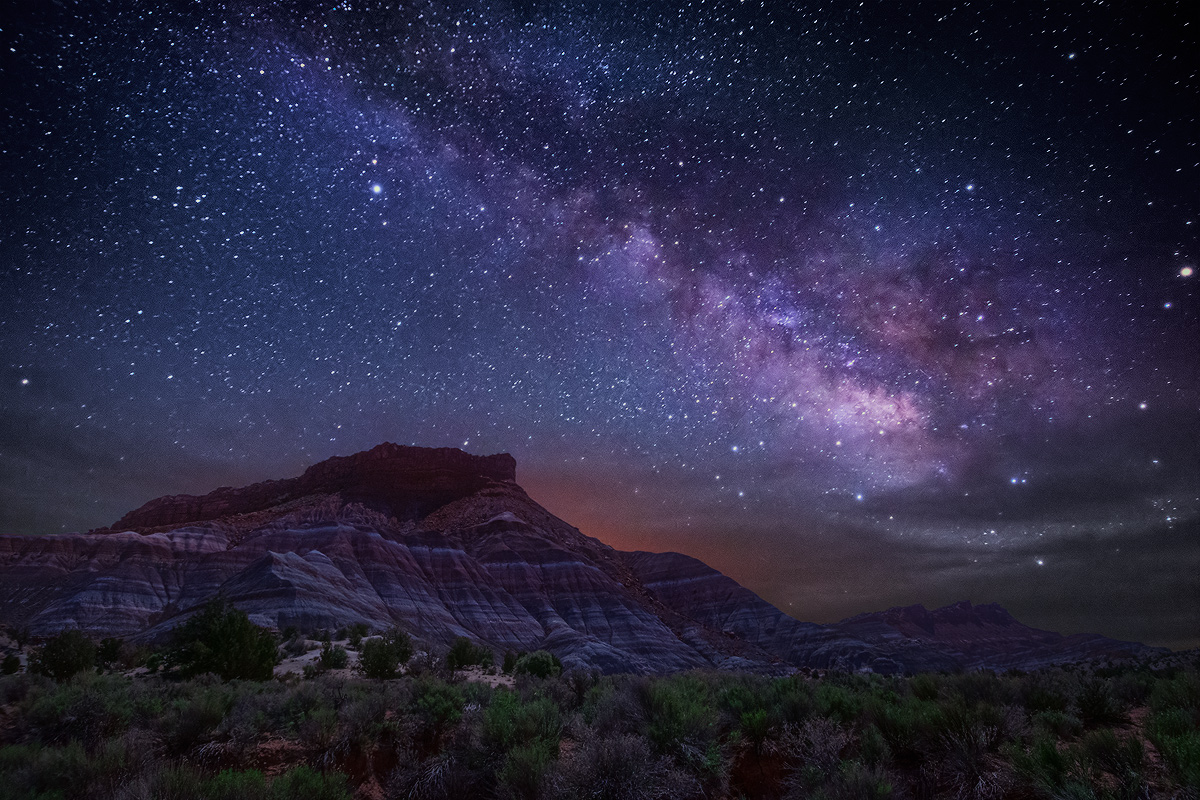
Life has conspired to keep me away from photography recently, so I processed an image from several months ago.
In April my brother and I camped in a wash at the edge of the road with this view of Old Paria in southern Utah. To get reasonable detail I took the foreground around 7 p.m. while the bright moon was still up, and after setting the alarm for 2 a.m. went to bed. When the alarm went off, I poked my head out of the tent and found the sky completely covered with clouds. Discouraged, I went back to sleep. An hour later my brother was making a racket outside my tent, and when I poked my head out I found this sky (and my brother asking something like, "Are you going to photograph this, or what?")
I played with lots of variations in processing, and finally settled on this color and saturation. YMMV; all comments welcome.
Nikon D7100
Nikon 12.0-24.0 mm f/4.0 at 12 mm (18mm equiv.)
Land taken at 7 p.m., 30 sec. at f/5.6 and ISO 3200
Sky taken at 3 a.m., 30 sec. at f/4.0 and ISO 3200

Comments
24 commentsA lot of detail in the land, a strong anchor with the formation and a nice milky way.
Very well executed.....
John
pat
Nick Bristol
Lone Rock, WI
When photographing, I was worried that the Milky Way raw image would contain little detail in the shadows. (This turned out to be correct; see the raw version of this jpg below.) I could have used the "Bulb" camera setting for a longer exposure, but the stars are borderline streaky as is. Any longer, and I would have lines instead of "almost" circular. I suppose I could have taken two images, one for the land with the Bulb setting, and another for the sky, so that they were less time separated. I worried, though, that reciprocity type issues might still leave the land shot with excess noise and elected to try the moonlit blend instead.
In the end, my personal priorities are artistic followed by realistic, rather than the other way around. I fully realize others have varying comfort levels and preferences, and I appreciate and respect the differences of opinion. I suppose that's why we get to call it an art, as apposed to just a science.
(A final thought; my opinion is that night shots are much easier to nuance with a black background.)
--P