Inquisitive...
From what I've seen, all young animals - including humans - have a high degree of innate curiosity. Which makes sense - ultimately there's value in understanding their environment - what is good and can be approached, what is bad and should be avoided, and so on.
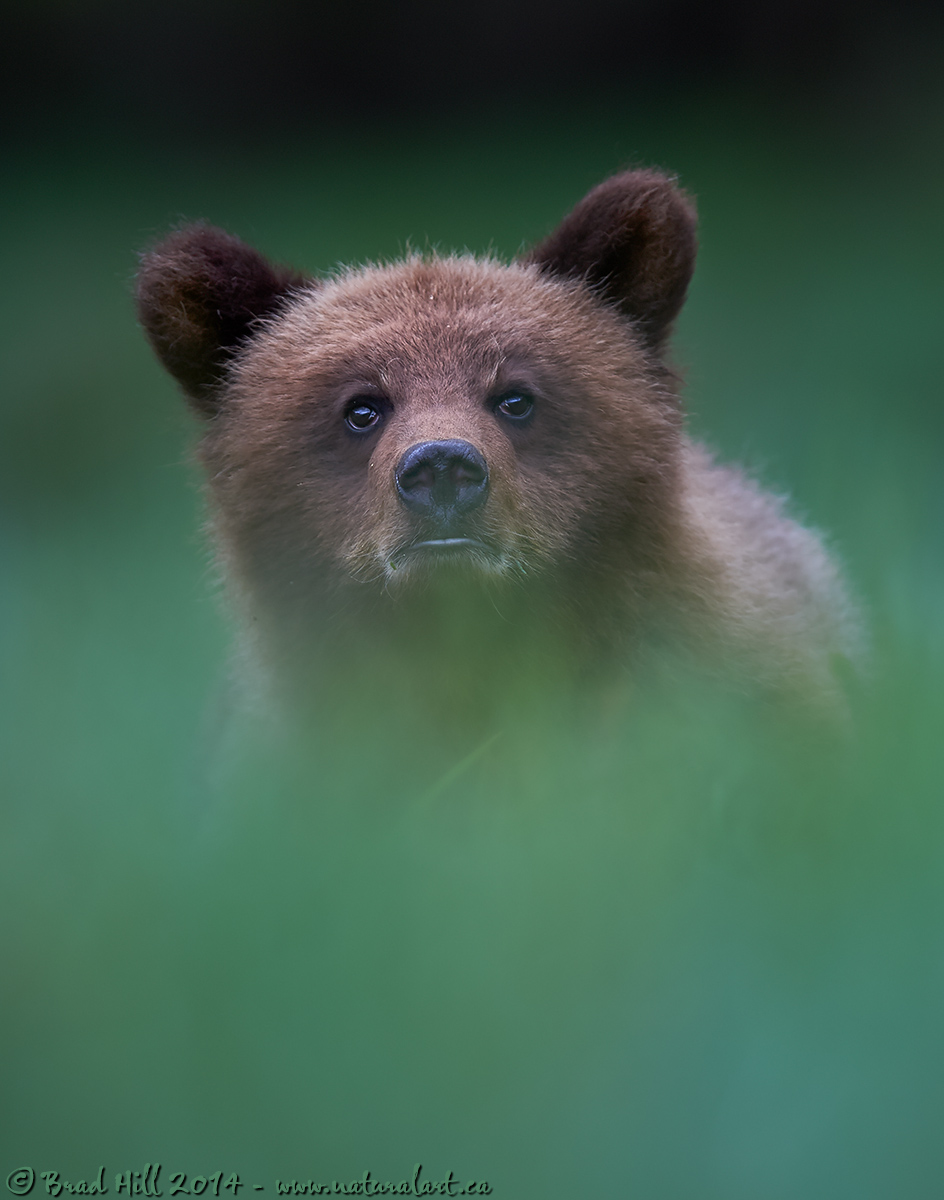
Bear cubs are no exception to this rule. Their initial reaction to a novel object or stimulus is often fear - and this is most often expressed by them scurrying off or clambering up a tree. But cubs take their cues off mom - and if mom doesn't follow suit and run off the cubs will often slowly return and show extreme interest in the object that initially scared them. And that's exactly what was going on here - a yearly grizzly cub couldn't resist checking out a weird gray floating object (with several upright moving appendages, each with a single HUGE eye looking at it!) that mom seemed to be cool with! Supreme curiosity. And that's what I hoped to convey with this shot - the cub coming directly at me with all sensory devices (nose, eyes, ears) engaged and with all the inquisitiveness it could muster up!
I shot this image directly through long grass that was quite close to me (much closer to me than it was to the cub). In this shot the grass was, of course, thickest at the bottom of the frame, but it extended up to about halfway up the cub's nose. Its snout - and everything at and above its eyes - were clear of the grass I was shooting through. I have to admit I was pretty excited at the time - I was quite sure that given the arrangement of all the elements in the shot (proximity of foreground grass, distance to background and to the cub) if I shot at a very wide aperture virtually all the grass would be thrown out of completely out-of-focus and rendered dreamy soft. So...I cranked the aperture ALMOST wide open and waited until the cub gave me a long, hard, look and fired away. Why didn't I just open up the aperture ALL the way? While the lens I shot this with (i.e., the 400mm f2.8 VR) is among the best in Nikon's lineup, you still have to stop down just a tad before you attain maximal image sharpness. So it was f3.2 rather than f2.8.
This was one of those rare occasions where the planets fully aligned and where your camera reproduces the scene (as you viewed it through the viewfinder) almost perfectly, with virtually no need for post-processing corrections. So in this case, the post-processing amounted to "convert raw file" (at default settings), resize, and sharpen for output". Ya gotta like when that happens!
Subject: Grizzly (
Ursus arctos) cub checking out the neighbours
Location: Khutzeymateen Inlet, northern Great Bear Rainforest, BC, Canada
Camera: Nikon D4s
Lens: Nikkor 400mm f2.8 VR. Hand-held from floating zodiac. VR on and in "Active" mode.
Exposure: 1/500s @ f6.3; ISO 200. -0.67 stop compensation from matrix-metered exposure setting.
Crop: Moderate - this is about 80% of full frame
More details about the image can be found here on my website:
http://www.naturalart.ca/galleries/latest/.
Comments and critiques welcomed - probably best to view the larger version prior to doing so!
Cheers...
Brad

Comments
11 commentsNeat result & I agree, "planets fully aligned" for this one Brad.. you were just there to click the button
Well done
Max
When I am sitting in a blind or waiting for a situation to develop into what I want to to create I try to think through the possible scenarios that may develop. I fully admit my shots often don't come off the CSMOS as well structured as I had hoped ! Any advise on what your mental "pre-game" might entail as you anticipate an exposure? (I know open ended question :)
Again - thanks for the way you present a great picture and and educate in the process !
Robbie
Thanks for the feedback on this one...appreciated.
Robbie: Good to hear from you - and thanks for your comments - super appreciated. And the question you asked is a great one. In a sense you're getting at the "essence" of the photographic process. Because I do a lot of teaching of nature photography - and especially wildlife photography - I've thought a LOT about the issue your question raises. To save anyone viewing this from scrolling around in search of your question, here it is:
"Any advise on what your mental "pre-game" might entail as you anticipate an exposure?"
While of course what you're thinking "pre-exposure" varies case-by-case, I'll try to offer some general thoughts that may help...
1. Technical vs. Creative? While I normally separate technical and creative aspects of the photographic process when teaching, in reality I don’t think this way in the field - out in the woods (or on the ocean. etc.) the technical and creative are totally intertwined. Unlike studio photography, nature photographers often have almost no control over the conditions, and because of that it’s my view that they have a much higher need to thoroughly understand the technical end of photography (so they know how far they can push a lens, or an exposure, or an ISO, etc.). BUT, you have to be SO familiar with the technical end of things that they become intuitive and reflexive. In this shot, for instance, I was thinking about how the visual contrast between the tack sharp parts of the bear vs. the totally OOF zones would make the shot, and I knew I had to open up the aperture to almost wide open to create that effect (but I wasn’t reviewing DoF tables in my head and thinking about 12 cm of DoF vs. 18 cm of DoF). I spend a whole lot of time looking for some form of visual contrast when I’m in the field (and a lot of time thinking of how to effectively capture it in the field).
2. Opportunity Recognition vs. Preconceived Ideas? I’ve seen a lot of photographers go into the field with a specific shot or type of shot in mind and try to almost force that view onto the scene in front of them. Consequently they often don't see a LOT of what they’re actually given - or, said another way, don’t recognize the full potential of the opportunity in front of them. I TRY (not always successfully) to keep preconceived ideas from giving me tunnel-vision, and when things are happening in front of me to just keep thinking “how can I present this in a unique way??” And…that means I’m often “changing gears” and changing my thought patterns and goals over and over again even when right on top of a subject - sometimes little things, sometimes big things (e.g., should I shoot this vertically or horizontally? Better to isolate the subject from the background or try to have everything in the viewfinder in the frame? Are enough key elements in focus to show the animal in its environment? How can I avoid having multiple bands of focus in this scene? And so on).
3. Shooting to Process vs. In-camera Results? I’m always thinking about how I’m going to process the shot BEFORE I shoot. One obvious thing is thinking about whether or not you can retain all the highlight details or, if blown, retrieve them in processing. A less obvious thing is thinking about whether or not you can see shadow detail in a specific region of the frame with your eye WHILE shooting - things like “can I make out individual hairs on the underside of the wolf’s neck with my eye?” or “can I see details in the heavy shade behind the subject?” If you’re not thinking about, and looking for, these kinds of details behind the camera how on earth do you know how much shadow and/or highlight detail to return to a shot in post-processing? If one is reasonably good in post-processing you CAN end up with a shot with WAY more dynamic range in it than the actual scene contained…and processing it with excessive dynamic range can look as bad as processing it with too little dynamic range! And…if you can, it’s also best to think about how dark (or light) the scene in front of you actually is - and thus where you have to return it to in post-processing (the camera isn’t likely to get it right - more often than not it will render it too brightly...given that we do much of wildlife photography during those “golden hours” when light intensity is diminishing).
4. Showing SOMETHING Different/unique About Your Subject. Personally I’m not a “lister” - I’m not too interested in just bagging new species (e.g., species “x”, “y” and “z” of antelopes). Note that I’m not saying there’s anything wrong with documentary photography, but it’s just not what I enjoy. As an example - I’m not in need of more images that are just “of a" bear. So…being liberated from the desire of adding new species to a list means that I can pass (and pass, and pass) on a LOT of shots and focus on getting something unique. With some species this might mean capturing personality (which is a major goal of mine when photographing most carnivores), with some it might mean capturing scenes that tell a story, and with others it might mean capturing dramatic action (flight shoots or running mammals, etc.). But the point is that because I’m actively thinking “nope, don’t need that, nope don’t need that, either”…I end up REALLY watching the animals and I am often ready to shoot (and not chimping!) when something really cool does happen. A bit of a fancy way of saying “I’m a selective shooter”, but that IS a part of what I’m thinking a LOT in the field - “wait, wait, wait, wait”.
I find that actual shooting part of wildlife photography mentally exhausting (but I love it). On photo tours I often tell folks that those who can think really fast and keep thinking when confronted by a dramatic subject (rather than being just in awe of it) are those who are going to come back with the best images…
Sorry this got so long…but that was one tough question! Hope this makes sense…and that it helps!
Cheers…
Brad