The Cute Trio
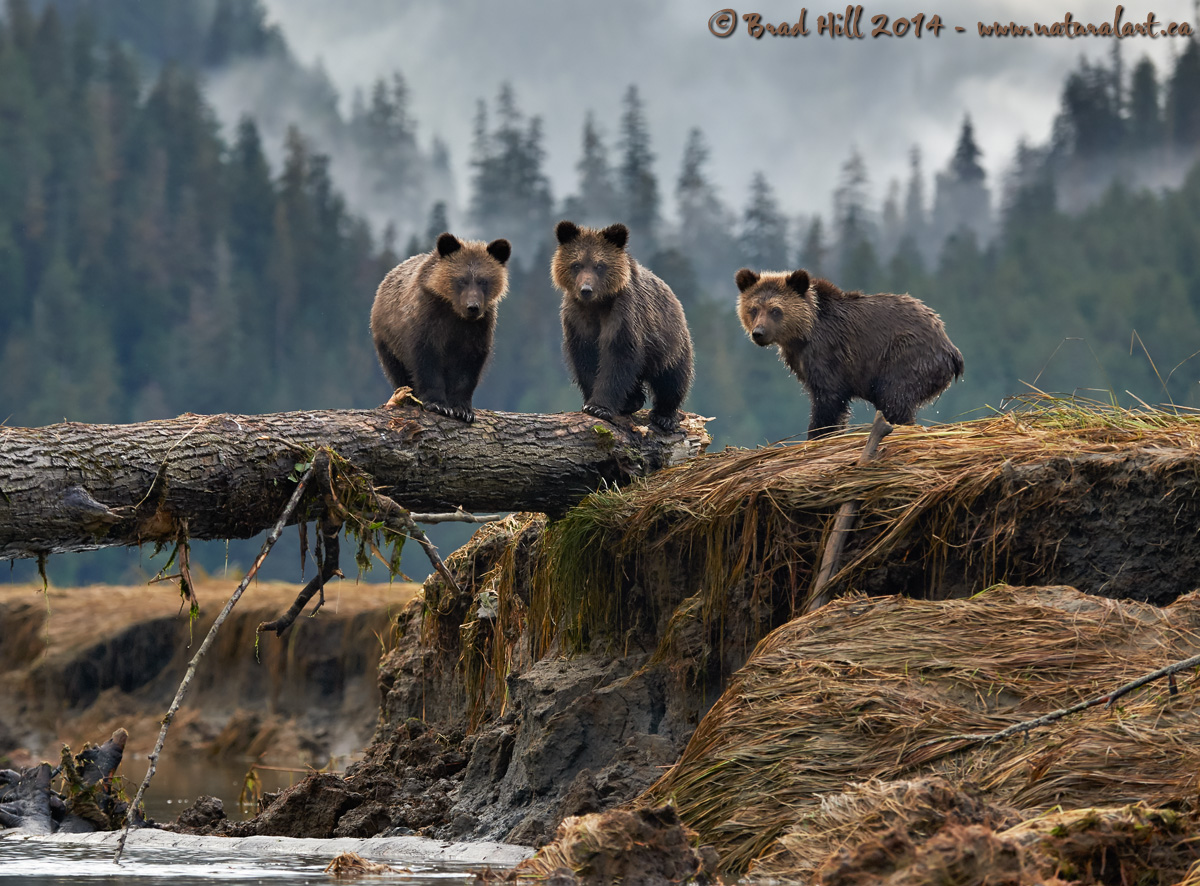
I don't know of anyone who doesn't find young animals cute. Indeed, some argue that the factors that help to define "cute" (including disproportionately big eyes and short "near-pug" noses) are part of an evolutionary strategy to reduce aggression against young, vulnerable animals - both from conspecifics as well as from members of other species (and the reality of natural cross-species adoptions is at least consistent with this argument). So...when these three grizzly cubs-of-the-year chose to give us this unforgettable pose in a remote inlet in the Great Bear Rainforest well...it was a wildlife photographers dream come true! I was with a group of photographers at the time and it was interesting that evening to compare the different approaches everyone took at the time (and I mean beyond the "crap, mine's out of focus" comments!). I had an 80-400mm lens in my hands at the time and chose to back off (to 260mm) and capture the moment as what I think of as an "enviroscape" where the subjects are shown within enough of the environment in which they live to give the image context (as opposed to an "animalscape" where the subjects are even smaller in the frame and shown within a much broader landscape).
Those who have been with me in the field know that I'm pretty obsessed with Depth-of-Field (DoF) issues when I'm shooting wildlife. I personally consider DoF as the most under-appreciated of the creative elements of wildlife photography (and it's one of the main reasons I shoot with high-speed super-telephotos - such as the 400mm f2.8E VR - a lot of the time...i.e., so that I can maximize the range of apertures and DoF options available to me). To me getting the DoF just right (for any given scene) is a fascinating exercise in problem-solving and optimization of variables. When you start dealing with two or more subjects your soft-drive's (i.e., your brain's) DoF optimization algorithm must shift - and in most cases the primary consideration becomes finding enough DoF to get the critical regions of all your subjects in focus. This can mean that another variable - which is often separating your subjects from the background through choosing the right aperture - has to be compromised. But this was one of those rare multiple-subject scenes where the subjects aligned themselves almost perfectly along the same focal plane (thanks little fuzz dudes!) AND the distance between them and the background was sufficient that I was able to render the subjects AND the background just the way I wanted. It isn't often this happens, especially with 3 hyperactive grizzly cubs!
Subject: Trio of Grizzly (
Ursus arctos) cubs posing
Location: Great Bear Rainforest, BC, Canada
Camera: Nikon D4
Lens: Nikkor AF-S 80-400mm VR @ 260mm. Hand-held from floating zodiac. VR on and in "Active" mode.
Exposure: 1/320s @ f6.3; ISO 1800. -0.3 stop compensation from matrix-metered exposure setting.
Crop: Minor - this is about 90% of the full-framed image
More details about the image - including a 2400-pixel version of the image - can be found here on my website:
http://www.naturalart.ca/galleries/latest/.
Comments and critiques welcomed - probably best to view the larger version prior to doing so (or better yet the 2400 pixel version on my website).
NOTE: In the spirit of full disclosure (which is important to me) - in my opinion this image crosses the line from simple digital processing and/or digital correction to digital manipulation. In the original capture there was a stout stick running from the log and up to the face of the cub on the left side of the image. It was removed during post-processing.
Cheers...
Brad

Comments
19 commentsFrom an aesthetic standpoint, I struggle with the potentially beautiful top half and a messy, slightly ugly foreground. Visually, the top and bottom are discordant to an extent... and I find myself wondering if you got any compositions that emphasize the cubs more against that lovely misty treed background (or if you'd consider chopping off much of the grass and mud beneath the log). The more I look at it, I think had the background been solid green, the heavy brown foreground might have worked much better as a solid base for this composition, but with those light clouds peeking through I feel the difference in tonality causes the two halves to tug at each other a bit too much.
Don't know if any of that made sense, but that was my initial reaction upon viewing.
Max
Thanks for the honest feedback. Here's an image shot a few moments earlier that addresses most of your issues (and previously posted here):
Congestion @ the On-ramp
It's somewhat amusing to me that a number of commenters on that shot wanted to see more below, including the river below ("I might have even gone wider or arranged it so one could see the River the bear was hesitant to cross"). Real different strokes thing!
In terms of the "messy, slightly ugly foreground" - hey...it's what it was, and in my view the foreground shows what it's like on tide-dominated coastal estuaries. And I actually don't perceive it as messy or ugly...to me it adds visual interest. I disagree with your comments on the background (re: you wanting solid green vs. the clouds), but your view is important and it will be interesting to see what others think! Feedback is always interesting and valuable.
Cheers...
Brad
Gotta love those little guys! An intersesting view from below their perch.
Bill
As for the foreground, I hope the mud/matted grass lovers don't hate me for what I said.
Max
Clinton
Seriously, the looks you're getting from these three, and their relative poses, are just mind-blowing. "Wildlife photographer's dream come true!" to say the least!
First, I started laughing when I read your comments about how important DOF is. not because I think that is a joke, but instead...before reading your comments my thoughts when viewing this were; Brad really seems to pay a lot of attention to his DOF. I don't think he could have chosen one more perfect for this scene. Seriously, that was what I was thinking. Sort of funny.
Second, on the first post of this, my comments stated, this has me wondering what they are doing up there on the log. Now, this image tells me more of the story. They were crossing a river. Because of this, I like the fact the river is included in the image from a story perspective. Yes maybe it pulls my eye a little, but it also is an important part of the story and because of this, I would keep it in the frame.
Grt, Ingrid.
Thanks for the great feedback on this shot. Thanks in particular to those who took a "position" on this shot and took the time to explain their rationale for having that position. In my view that's EXACTLY what these image critiquing galleries are about and what makes them so valuable. Overall I think this was a great exercise in examining alternate viewpoints and gave a lot of viewers pause for thought.
Regarding the image itself: As John Launstein pointed out, I DID have reasons for composing and presenting this shot as I did and of course I considered the issue of whether the foreground would distract or add to the shot. In the end I decided that - at least for me - it helped complete the visual story and was essential. Personally I think even cropping out a LITTLE off the bottom (and removing the water) would be a mistake - while even tho' they don't occupy a lot of the frame, the cubs dominate this composition and I highly doubt ANYONE's eyes went to the water before the cubs (I have no doubt the eye would have got to the water when exploring the image AFTER looking at the cubs, but that's kinda the point!). On that note, I think cropping tighter and/or removing a bunch of foreground to "better emphasize the cubs" is totally unnecessary in this shot...they're pretty dominant already. So this will be the way I continue to present the shot moving forward...
Thanks again for all the feedback - and for taking time to go beyond those "nice- to-hear-but-not-too-useful" one line critiques!
Cheers...
Brad
Great image all round in my books (though I enjoyed the discussion between you and Max up top)