Dwarfed
I know this shot doesn't really lend itself to an online forum (even at 1200 pixels), but hopefully it will work well enough for some.
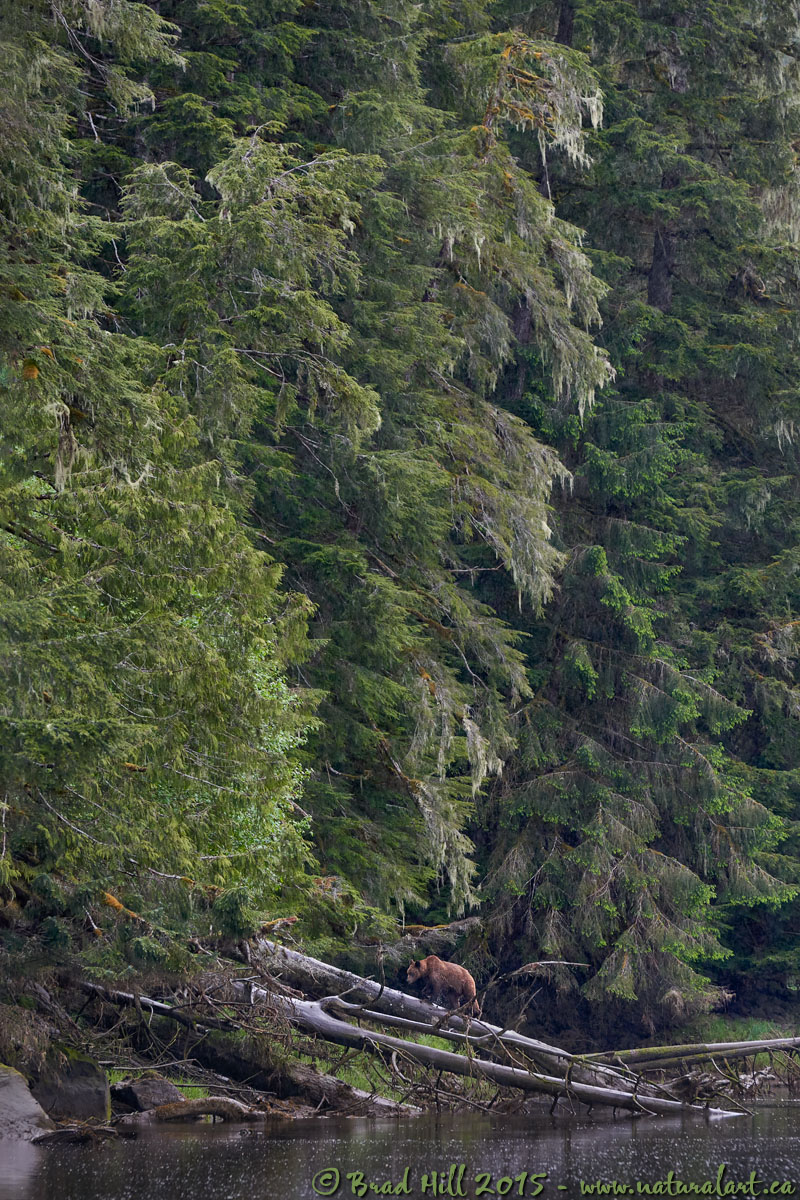
Unless you've spent some time in coastal rainforests it's hard to appreciate just how BIG everything is - especially the trees that make up that rainforest. We had been watching this grizzly wade its way along the shoreline at the head of the Khutzeymateen Inlet when it decided to walk up a natural "ramp" and into the forest. For the bulk of time we had been watching the bear I had been shooting with my 400mm f2.8 VR lens and, consequently, most of the time I had been watching a tighter view of the scene as seen through my camera's viewfinder. Just before I shot this image I put my camera (with the 400mm mounted on it) down and was instantly struck by how the massive trees in the background completely dwarfed the bear - and just how beautiful the wider scene was. Fortunately I had my "animalscape" camera set up (at the time a Nikon D800 and 70-200mm f2.8 VRII lens) handy and was able to quickly change gears and capture this image.
As time marches on I find myself gravitating more and more towards the challenge of shooting animalscape shots (rather than just "closer is better" shots) of wildlife. This doesn't mean that I don't appreciate (or still shoot) good portraits or more tightly framed shots of wildlife, but I'm ALWAYS on the lookout for scenes with wildlife that lend themselves to creating good 'scapes. Watching for (or being receptive to) good animalscapes is valuable in itself as it can take you out of the "tunnel-vision" mode that it's easy to fall into if one goes into the field with a
"MUST get a full-frame shot of the animal" mental framework. There is SO much more to good wildife photography than just "getting close" to an animal.
Animalscape shots also test one's post-processing skills. My experience is that many or most wildlife photographers (including both pros and advanced amateurs) consider developing strong post-processing skills as a necessary evil (at best!) and some even resent spending time behind their computers (they'd much rather be out in the field than spending time in their digital darkroom). But to create appealing animalscapes a photographer has to be comfortable making a lot of selective adjustments to an image, especially nuanced and selective adjustments to exposure and contrast, some of which may require advanced masking techniques (such as using multiple luminosity masks on a single image). In creating this particular image I combined 3 separate exposure variants (from my raw converter) using two different luminosity masks, plus three separate selective adjustments to contrast (again via careful selective masking). And, portions of the image required colour desaturation. Note that making multiple selective adjustments to an image can be necessary to RETURN the image to what you observed in the field (rather than in a creative direction that moves the image AWAY from what saw). Why? Because while our digital cameras are getting more and more amazing with each model release, they still aren't perfect - and they don't always render a scene "as seen".
Subject: Adult grizzly (
Ursus arctos) heading into the rainforest
Location: Khutzeymateen Grizzly Sanctuary, northern BC Coast, Canada
Camera: Nikon D800
Lens: Nikkor 70-200mm f2.8 VRII - hand-held from floating zodiac. VR on and in "Normal" mode.
Exposure: 1/200s @ f7.1; ISO 1100. -1.33 stop compensation compensation from matrix-metered exposure setting.
Crop: Very minor - this is at least 90% of full-framed original
A lot more info about this image - including including a higher resolution version (2400 pixel) - and processing info can be found here on my website:
http://www.naturalart.ca/galleries/latest/.
Comments and critiques welcomed - probably best to view the larger version prior to doing so!
Cheers...
Brad
PS: Like all wildlife images on my website and that I post on NPN, the subject is fully wild and completely unconstrained. Besides the potential impact of my presence, nothing has been done to intentionally alter or affect the ongoing behavior of the subject and, of course, there has been no use of any form of bait or other form of wildlife attractants (including vocalizations)

Comments
9 commentsMy only nit on this is the reflected rock in the lower left corner... it's one of the lightest spots in the whole image and pulls my eye a bit. You could crop the reflection out - but you lose valuable water (showing raindrops). You could crop from the left or you can always do a little digital editing (which you're not one to partake in usually so...) but overall it's a stunning image and provides the viewer with a lot of context
Like the diagonal tree trunks, Bear is climbing. I would love to see the next one or two frames, when Bear cleared the branch, which is coming in front of its hind legs.
Jagdeep Rajput
I personally love the processing portion of wildlife photography, and am grateful that my dabbling in landscape photography (and its subsequent processing challenges) has helped me mold my wildlife workflow into what it is.
Those trees look HUGE, would love to trawl this inlet with you someday...