
by Gary Yeoh
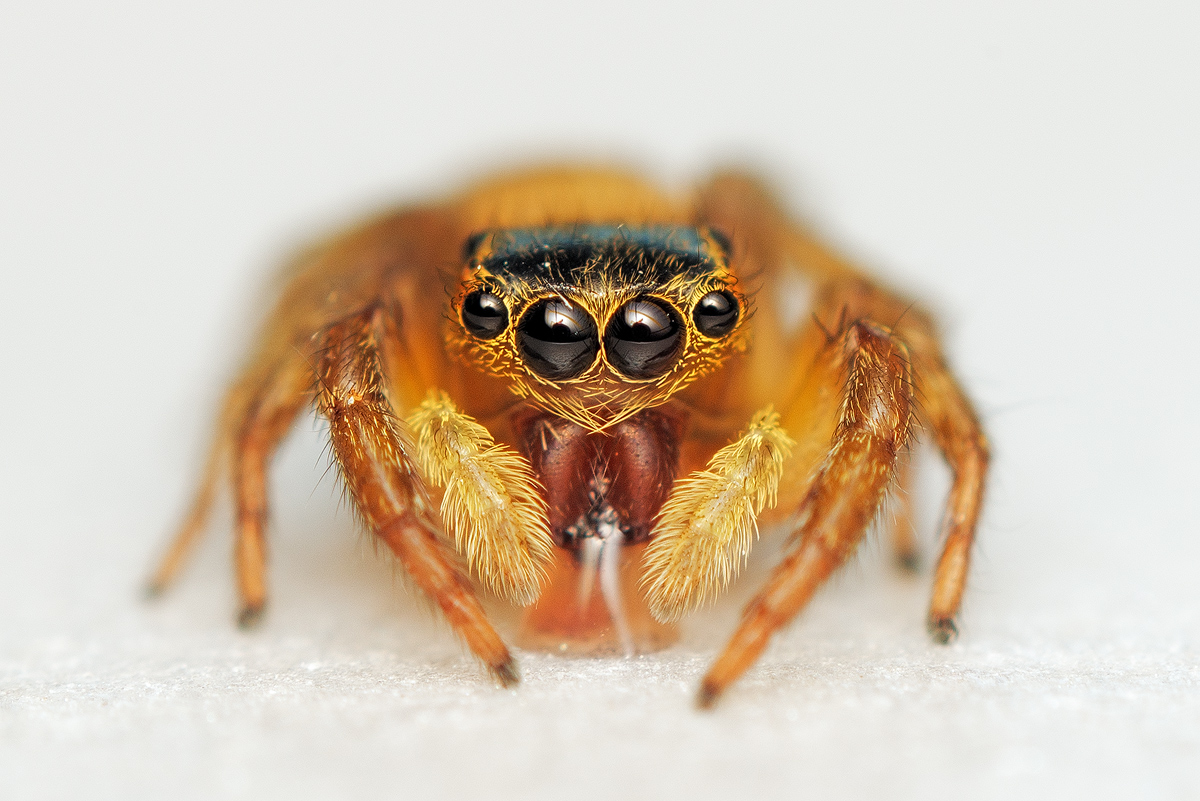
Jumping Spider
A friend gave me a very old >30 years 50mm manual lens with some stains at the edge of the glass. I took it to my local Nikon service center for cleaning and they declined to do the work as they do not have the parts for it. Since I have a reverse mount with a 52mm ring in my cupboard, I decided to reversely mount this lens with a 68mm Kenko extension tube and use this for macro work. The set up gives me about a 2x magnification which is just perfect for this small jumping spider (Carrhotus viduus).
D610 reverse mount 50mm+62mm extension, around F11, fill flash, hand held, manual focus (moving camera back and forth)
Comments
16 commentsGary,
Amazing technique for amazing results !
The thumbnail jumps out at you and the large version backs it up.
Well done . . .
Gary.....a big applause.... ...for your dedication to working up the gear to perform the experiment with here. The results prove it was worth the effort. I recall over 20 years ago a local camera shop salesman showing me the reverse 50mm trick too. Seems like a life time ago now, but obviously still a good usage for the process overall.
Gary, the colors and sharpness are outstanding. Those eyes really pop. Getting 2X magnification on a living critter is quite a feat. This also gets my stacking instinct humming as I think it would be neat to have all of the front two legs sharp if you could get the subject to hold still and you had a way to quickly move the camera or adjust the focus....
I'm still trying to figure out your rig...was the reversed 50 on a regular lens and that lens on the extension tube. I well remember the "reversing" idea for high quality macro. I never tried it, but I did own a "short mount" macro lens...that required at least 20mm of extension tube in order to be mounted on the camera. How nice to have modern macro lenses that go to 1:1 although my short mount lens was optically optimized to go to 2:1.
Perhaps my favorite animal! I so like these jumping spiders, they are magnificent. This is a very nice capture of one of those beauties, no nits for me! I too have started to experiment with a reversed 50 mm and a very old pentax bellow that I altered to make it fit on my Nikon stuff. A very nice way of experimenting for sure.
Hi Gary,
Those old, legacy lenses are wonderful.I like the shallow DOF and details in the in focus areas. I wish there was enough DOF to get the prey in the chelicera in focus too. Eyes and fuzzy palps are very nice ...........................Jim
Unique and impressive! Thanks for sharing.
Interesting set-up Gary, works very well for very tiny subjects like this one.. Excellent results.
Couple of questions. Was this indoors? What is the substrate here? Lastly, what's the conical shaped fluid? at the fangs there.. Is it prey? Just curious.
Well done!
To answer Mark's question, I have included an image of the rig. I use the on-camera flash for fill which is convenient, light without adding extra gear (BTW you can see the diffuser reflected in its eyes). Using a 35mm lens with this set up gives a magnification of around 3x, so the shorter lens gives higher mag. I have also tried this with a old 80-200 zoom with a pump action zoom mechanism and this goes up to 0.5x mag without the extension ring; The focussing can be done by moving the telescopic zoom mechanism back and forth. However, at 0.5x, a macro lens can do the job much more neatly and efficiently. Getting a stack with this set up would not be possible as one has to handhold this rig for the focusing. One could use a macro-rail but the subject is not likely stay still or stick around for very long. I have seen stack pictures posted on the internet and my guess is they use a macro lens with automatic focus rather the rig used here.
Jumping spiders may look cute with their big eyes and antics but they are really deft assasins and cannibals. I saw this guy jumped another small spider and promptly decapitate it with its fangs. The conical shape thing that Howard mentioned is left over gelatinous parts of the decapitated prey - I think they suck the fluid out of the prey rather than devour their prey??
Terrific head on macro image, Gary. The detail is superb (especially for hh), and I like the orange and black colors on the high-key bg. Great result with the veteran equipment.
Wow, Outstanding image of a spider. Good learning from you Gary.
You've captured the ultimate macro shot!!! The detail is amazing. Hate spiders and if I get bitten I'm dead, but in this photo his looks are fascinating. Good to be able to see a close up instead of seeing him in person.
Gary ...must be the fourth time im visiting the image..A fine image with a lot of detail. The lens reversal does produce some extraordinary image. In this particular case,, its your skill of getting a freeze frame. well done
Balan Vinod