
by Howard Cheek
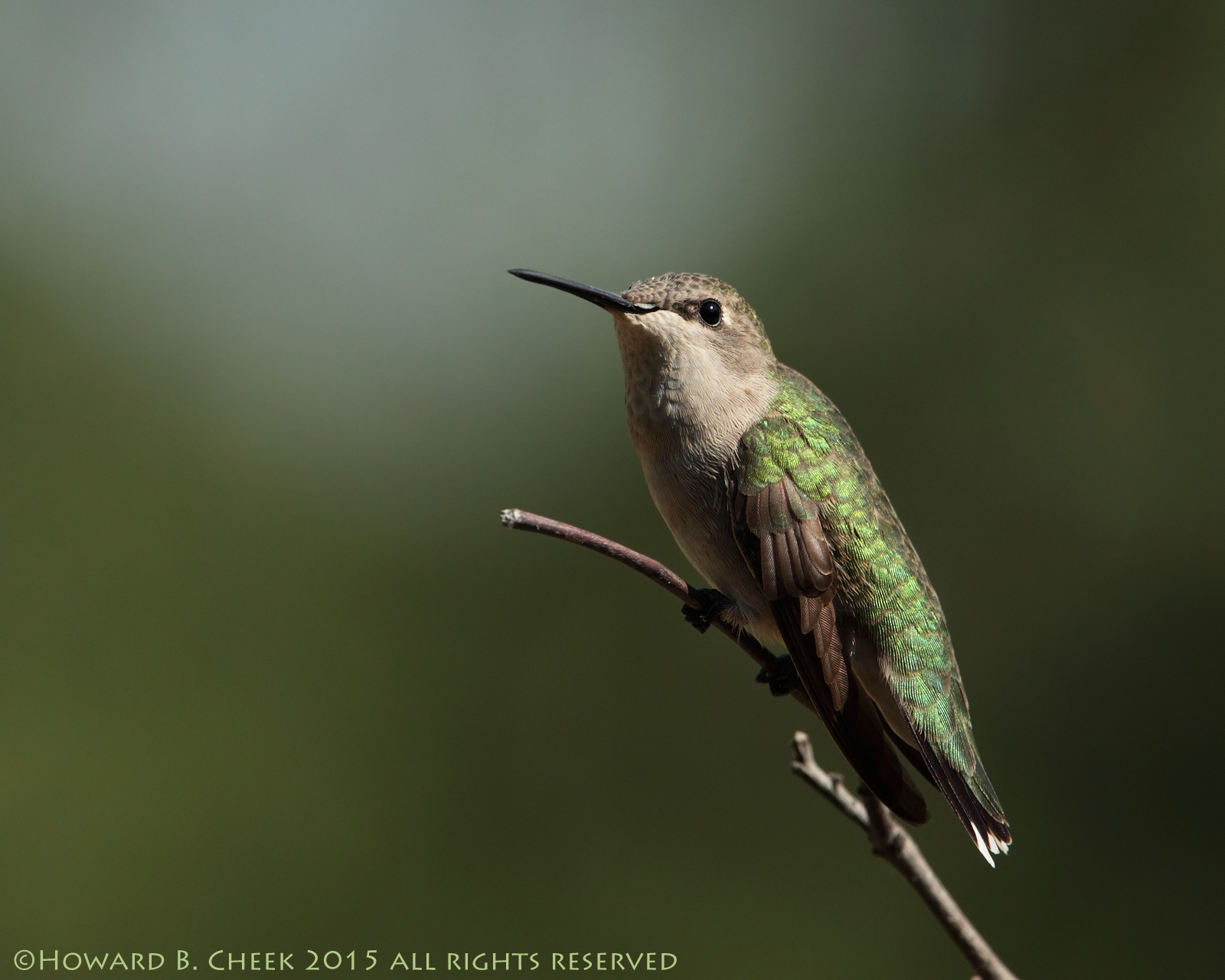
Black-chinned Hummer female in sunny morning light, no flash.
I've always been amazed with the exotic colors of hummers to the south.
But this regular migrator has a beauty all her own, on this I think you'll agree
F/11, 1/800th, ISO 640, 5DM2, 300mm f/2.8 + 2x ext. @ 10:45am & clear.
Post Script: There's is a case to made for fill flash in this kind of light, of this I'm fully aware.
The negatives being flash tends to be one dimensional and 'flater'.. It also changes/alters the subtle color differences you often see in the plumage. And then there's the flash 'startle' factor. With a perched hummer like this, you would get one snap & it would be off. Anyway, curious as to your thoughts?
Comments
10 commentsHoward, as a natural light shooter only I can't comment too much beyond saying if the light is good such as seen here, what would be the need for any type of flash?
I guess I could see the point of a flash from the bottom to bring out more in the lower portion overall, but there is detail in the darker areas as well as understanding what is really there in general. One would not know unless tested and placed side by side. I will say in my earlier years, 35mm wildlife shooting, I did use a 300mm f2.8 and 1.4 or 2 x extenders to photograph hummers too. However, using either 200 or 400 ASA films and birds in flight the flash was key to any chance of stop action. Obviously not the case here.
Anyway, just enjoying the heck out of the neat take here as it's presented and the overall detail in the feathers is stunning as always with your avian takes. So, maybe the point on flash and flattening those details is the biggest point to be made. Again, maybe a fill flash from the bottom might not interrupt the upper feather details either, but hard to say......
.......as always it is all about our experimentation in the wonderful art of photography......
Sweet pose and lighting, Howard. The one white tail feather looks like it's about at the limit, but the rest looks like it could be brightened just a touch, though I like the semi-mysterious look. Personally, I don't use flash much, but that's probably just because I'm lazy. I've seen people who really know how to use it and make it work. However in this case it would have removed that nice shadow, which would have been a shame. Flash is particularly good for field guide images, but my personal taste is for more interesting lighting.
As I think most people are aware, I'm a huge advocate for the proper use of flash. One dimensional or flatter flash is almost always created by on-camera flash. The flash really needs to be off camera, and hopefully off axis. On this image a suble use of fill flash would have helped the overall image by dealing with the large shadowed area. It would NOT have removed the shadow, if done correctly.
Certainly not every image benefits from the use of flash, but there are many that do.
Overall, I like this image, but even before you added the postscript about flash, my first viewing of the image was that proper fill flash would have benefitted this image.
These look familiar ! The catchlight is present and the shadows add a lot of depth. A small amount of flash could help the image, but it is an aquired taste. I have been dabbling with flash photography for hummingbirds and like some of the results, but it takes a while to get it right. I think the lighting in this shot is OK and the hummingbird stands out from the BG......................Jim
Really beautiful, sharp, and clean shot of this hummer. I like the lighting as well as the shadow area. I think fill flash might have been helpful here, but I have little experience with it. If I knew what I was doing (and owned a flash unit), I would probably give it a try in this situation. In any case, this is a very appealling image.
I like it as posted Howard. The color coordination with the bird and backgound is great!
Thanx everyone for commenting!
Keith: The simple fact is I wasn't set up for the hummer shot, or I probably would've used light fill flash Keith. I will say that if I had used flash, I would've had far fewer snaps to get this particular pose/shot. From my experience, they take off after the first flash (startled), especially when perched. Without flash, I got off at least a dozen clicks before the hummer flew off..
Thanx again
Nice colorful image of a hummer I'll never see in the pacific northwest. With respect to the flash issue, I can see both sides. In western Washington, it is cloudy about half of the year and getting adequate light isn't easy. I experimented with several flash setups but always found the birds got startled after the first flash. Clearly Keith and others have this figured out. So I know it can work.
Nice little bird Howard ! The pose isn't bad either ... No experience with flash&birds, so cannot comment anything about that I'm afraid, but read the reactions with great interest ! Cheers, Hans
Howard,
I do not use flash at all , although clearly in some circumstances it can be suitable, and those with the skill, patience and time to use it certainly make it appear OK rather than artificial.
I am with Hans on this one.
Your image is great as is, it looks totally natural