
by Brad Hill
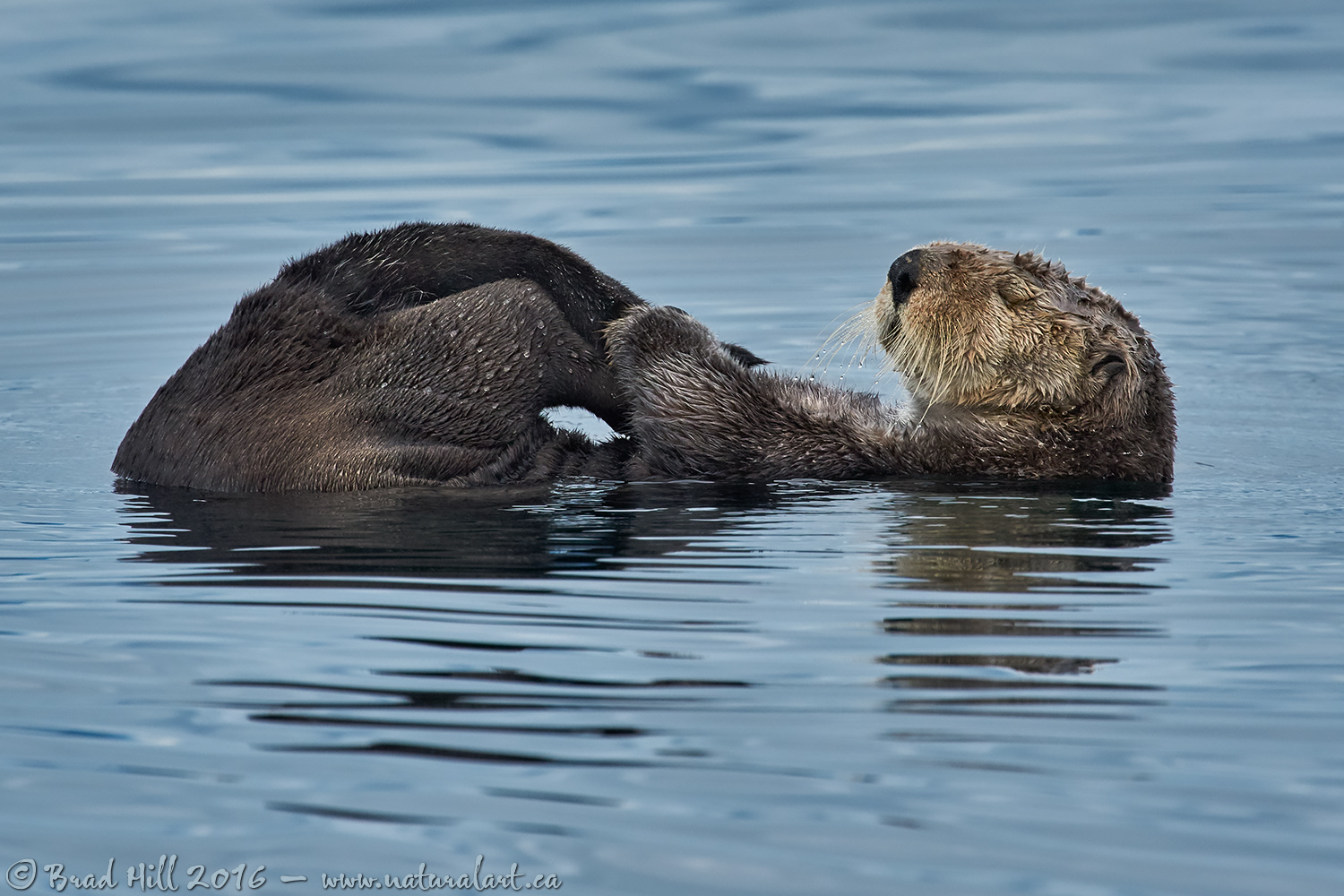
Water Bed
I find sea otters fascinating. Evolution is never fully linear - it doesn't necessarily move towards a single, unitary "solution" to a life problem. Over time a lot of different solutions or pathways are "experimented with" (teleologically speaking, of course!) to solve basic problems faced by all life. As a warm-blooded animal living in a cold, aquatic environment sea otters (and all other marine mammals) must find a way to battle heat loss. Every single marine mammal on earth - except the sea otter - does it by adding a thick, insulating layer of fat (or "blubber") under their skin. Sea otters have come up with (again...teleologically speaking!) a totally unique solution; they use a thick, luxuriant coat - combined with a high metabolic rate - to fend off the heat-sucking properties of the water they live in. That coat requires constant care (preening) to keep it filled with natural oils (for water repellency) and filled with air (for buoyancy). When sea otters coats have just finished caring for their coat - an almost never-ending job - they are amazing buoyant and almost float on top of the water. THIS sea otter has JUST finished a long preening bout (finishing with its curled tail) and is dropping off to sleep, laying on top of the water - and making it look like a firm mattress or water bed! No worries about this cute fuzzy dude sinking!
Back to the image: On the creative side...I chose to keep this image subtle and kind of "low key" during post-processing. We had a mix of sun and cloud at the time I shot this, and most of the otter was "lightly shaded", with only the left hip and facial region getting slightly more direct light (though still not direct sunlight). To me the visually appealing aspects of the original scene were the water droplets, subtle tonal (and hue) shifts on the coat of the otter, and those faint "beams" of light. Of course, I didn't particularly mind the cute pose of the female sea otter! 
Subject: Curled Up Female Sea Otter (Enhydra lutris) falling asleep
Location: Northern Vancouver Island region, BC, Canada
Camera: Nikon D750
Lens: Nikkor 400mm f2.8E VR plus TC-20EIII (2x) teleconverter (800mm total focal length). Hand-held from floating Zodiac, VR on and in "Sport" mode.
Exposure: 1/800s @ f11; ISO 1400. +0.67 stop compensation from matrix-metered exposure setting.
Crop: Almost none - this is at least 95% of full frame
A lot more info about this shot - including a discussion of a "unique" use of the Shake Reduction filter in Photoshop, and a 2400 pixel version of this shot - can be found here on my website:
http://www.naturalart.ca/galleries/latest/.
Comments and critiques welcomed - probably best to view the larger version prior to doing so!
Cheers...
Brad
PS: Like all wildlife images on my website and that I post on NPN, the subject is fully wild and completely unconstrained. Besides the potential impact of my presence, nothing has been done to intentionally alter or affect the ongoing behavior of the subject and, of course, there has been no use of any form of bait or other form of wildlife attractants/luring devices (including vocalizations or sounds)
Comments
7 commentsInitially I had thought of a pano crop, but on reflection I like the additional space in the FG, as to me, it helps lead the eyes to the subject.
TFS
Steve
Love it all the way.
Jagdeep Rajput
Bill