After the Flurries
by Lon Overacker
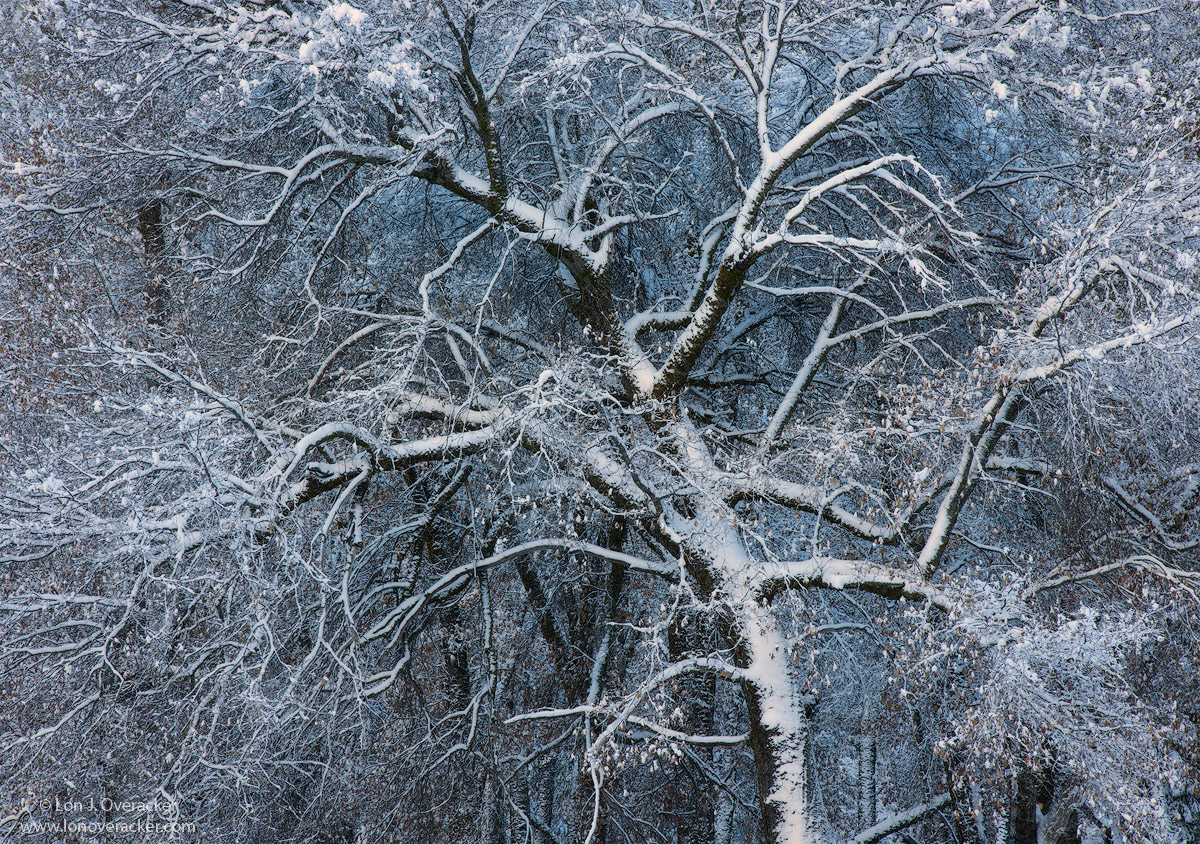
Same tree, less than 24 hours later. This day, was my birthday. The storm had cleared, blue bird skies and the valley covered in a fine blanket.
I'm not posting this to compare to the previous image but to illustrate how light and color can be so different. As often as I can remember, I want to pay attention and take notice of light and the color of light. Some times we spend so much time with compositions, lens selection, camera settings, capturing the moment, etc., how often do we take time to make mental notes of color? what are the colors when the light is direct? diffused or reflected? Are you able to detect those subtleties before you get back on the computer? Try it as an exercise next time you're out.
Of course the next question is, can you convey your interpretation afterwards? this is my attempt at that. The mood, atmosphere, etc. are completely different from the previous post. Yes, the comp is different and the conditions have changed and the light changed dramatically. Previously, it was snowing, everything was pretty much neutral, the valley was socked in and snowing. No color to speak of. This day, actually close to noon, the sky above was blue and the sun was beating down on El Capitan. Yet, during the winter, the sun just doesn't quite get high enough and the valley walls are so high, that the scene before me was in open shade. So, El Cap is a gigantic reflector, bouncing warm light off the wall providing some warm, frontal lighting to the scene. Yet, deep within the trees the warm light can't reach and we can see the colder, bluer light still present.
I'm very curious to hear your thoughts on this one. I suspect there might be a mix on whether or not the blue/cyan is too strong, or even the color temp of the front side of the tree and snow.
Just for grins, I'm gonna post a wider view for context. It's a very slight crop from original, color temp in RAW was set to 5500 and the only thing done in processing besides the crop and sizing/sharpening for the web, was a saturation adjustment actually reducing blue and cyan about 15pts each. Also, you get an idea of the surroundings. the granite wall behind eventually grows up to Cathedral Rock.
Enough rambling. thanks for your thoughts on this one.
Nikon D800E
Tamron 24-135mm @100,mm
f/18 iso 100
Tony Kuyper's masks and actions.
Thanks!

Comments
15 commentsAnd thanks for posting the wider view, interesting to see things in a wider perspective!
- Dan
Nick Bristol
Lone Rock, WI
Interesting too because I only posted the wider landscape view for reference. I really had no intention of spending any time on it. But some folks actually liked or even preferred it. Just goes to show how we all have our own personal choices and visions. For me at least, the landscape view is the obvious and easy choice. Most everyone sees that. Extracting images out of the larger scene is what I look for; at least most of the time. But some times I need to see the forest for the trees some times too.
Thanks again!