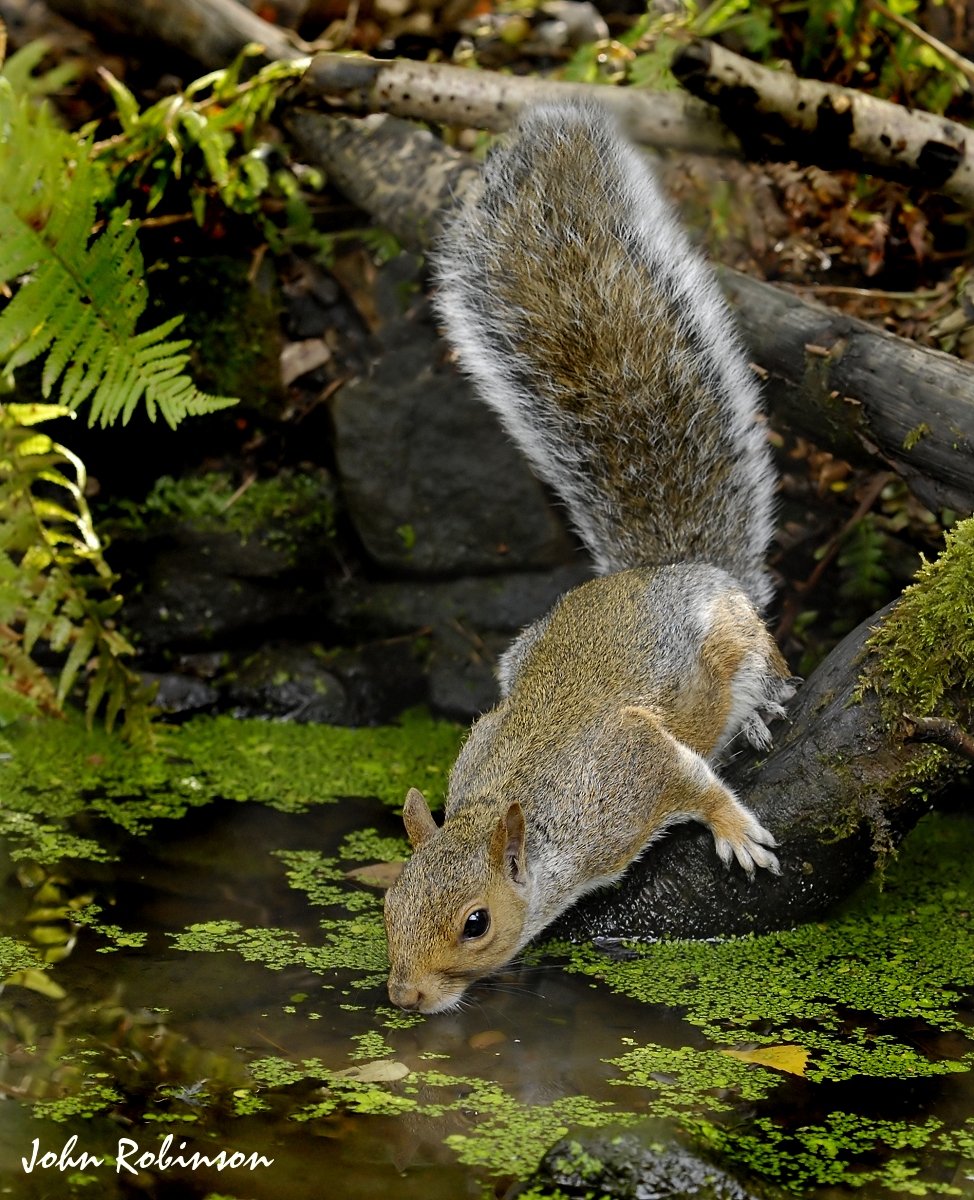
Grey Squirrel
by John Robinson
One of yours . Not very exotic I,m affraid
Rework from a while back Makes a change from birds at the pool
Gret Squirrel at the old pool in the wood. Been too dark in there lately but leaves coming off will help.
D200
Sigma 100-300
500ISO
80th @f8
Cheers
JohnR

Comments
14 commentsI am surprised by 6 views no comments.
I agree that it is a pity that it is not the native Red Squirrel, but considering their extreme rarity it is hardly surprising.
This is a real beauty, well captured in a great pose.
Appreciated
Yes Ken-Red would be nice but most are done at set ups or "pay to view" and my budget doesn't go that far.
Cheers
John
Thinking about it-I,ve had them down to my pools quite a lot over the years.
I usually make funny noises to scare them off !!
Cheers
JohnR
Jagdeep Rajput
Glad you like it.
JohnR
Invader or not it is still a very solid image! The pose is excellent, techs are solid, and I like the almost complete "vignette" of green surrounding the squirrel. And I definitely prefer an "au naturel" photography over set-ups any day!
Thanks for sharing this one...
Brad
Interesting and disturbing subject though. We consider these invaders in California and most of the Western U.S. as well. We call them Fox Squirrels, or Eastern Fox Squirrels. They have almost completely displaced the native Grey Squirrels in most of California. Wikipedia has a link to a paper on their invasiveness which I have included a small clip of here.
"TREE SQUIRRELS AS INVASIVE SPECIES: CONSERVATION AND MANAGEMENT IMPLICATIONS
GEOFFREY H. PALMER AND JOHN L. KOPROWSKI, School of Natural Resources, The University of Arizona, Tucson, Arizona, USA
TONY PERNAS, Florida/Caribbean Exotic Plant Management Team, The National Park Service, Miami, Florida, USA
Abstract: The impact of invasive species on native biodiversity is increasing worldwide. Mammalian invaders are formidable ecological and economic threats, and tree squirrels are models of such challenges. We review the worldwide distribution of tree squirrel introductions and detail their nearly universal success. The biological characteristics of tree squirrels that enable success as invasive species are: high reproductive potential, high vagility, diverse food habits, ability to construct nests, and plasticity in human-impacted landscapes....."
I think this is an Eastern Gray Squirrel (Sciurus carolinensis) - a species which is an invasive in Britain. It has largely replaced their native red squirrel (S. vulgaris). You are spot-on regarding the impact they can have when introduced to areas with other smaller species of tree squirrels. In western Canada this same species has displaced our native red squirrels (Tamisciurus hudsonicus) in many cities (e.g., Vancouver, Calgary), but in rural areas the grays don't do well.
Cheers...
Brad
Thanks again.
JohnR
Congrats on WP John!
Appreciated indeed
John