Spirit Bears are extremely rare, white-phased forms of the American Black Bear (
Ursus americana) - it is thought that between 200 and 300 exist on the planet. The white coat colour is controlled by a recessive gene which, for some unknown reason, occurs in higher frequency on a remote and tough to access roadless portion of the northern coast of British Columbia. On a few islands in this region between 10 and 20 percent of the bears are white Spirit Bears.
Spirit Bears are extremely challenging to photograph. The first reason for this is obvious - they're darned hard to find! And, if/when you do find them, you'll usually find that you're along a creek in the Great Bear Rainforest, which means that you're likely to be in a situation that is very poorly lit (and, not uncommonly, it will be raining). Finally, to compound the difficulties even more, if you're a photographer looking to capture shots with "catch-lights" in the bear's eyes - good luck: adult Spirit Bears have black, black eyes - and very long light-blocking eyelashes (much longer than their black-furred colleagues have) - that just suck up the light and seem to almost never reflect it back! While the name "Spirit Bear" comes from the significance of the white bear's role in native culture, I'm beginning to think the name is now being perpetuated by photographers frustrated by their inky black eyes that absorb light like a black hole in an almost ghoulish or zombie-like fashion!
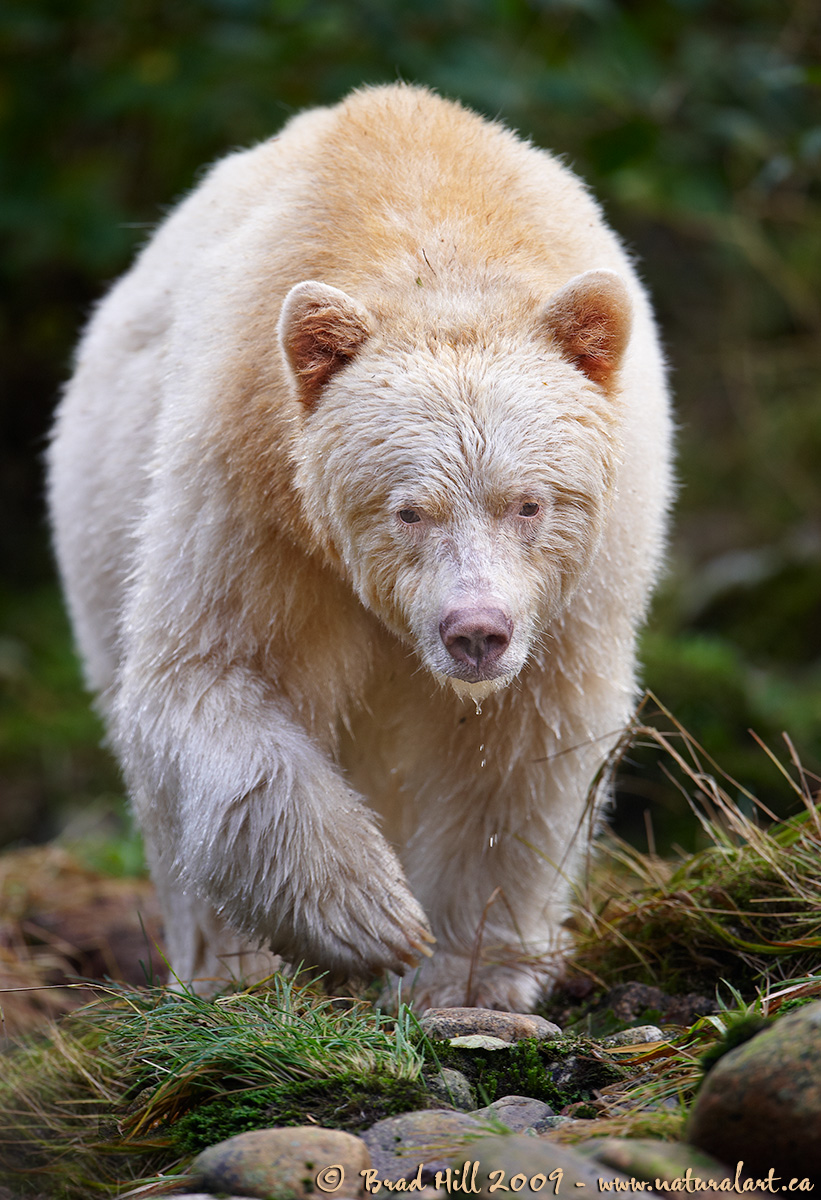
I captured this Spirit bear "bearing down" on me (pun fully intended) along the side of a stream in the Great Bear Rainforest. The biggest challenge on this shot was finding a way to keep the critical regions of the bear AND the foreground in focus, all while freezing the motion of the paw with a relatively slow shutter speed (dictated by the low light). Fortunately for me, the bear chose a path which included a few spots where the foreground stacked up just right (to be in focus at the same time as the head). And, to freeze the paw, I tried to time my shutter so that it corresponded to the motionless apex of the walking movement...
A final word on the bear's eyes. I'm proficient enough in Photoshop to add convincing "catch-lights" to one or both eyes. But...to be blunt, this simply isn't my style. And, in this case, I find conveying the image closer to "as seen" more important (and interesting) than conforming to a rigid ruleset about what works (and doesn't work) in presenting an image.
Subject: Spirit Bear (
Ursus american kermodei) bearing down on a dumb photographer
Location: Northern BC Coast (Great Bear Rainforest), Canada
Camera: Nikon D700
Lens: Nikkor 600 mm f/4G ED-IF AF-S VR lens - supported on tripod. VR on and in "Tripod" mode.
Exposure: 1/200s at f4. ISO 400. -0.33 stop compensation from matrix metered exposure.
Crop: Negligible (less than 5%) - sliver removed from bottom of image only.
All the contextual information surrounding this shot (field notes, all camera settings and processing details, conservation, etc.) can be found at:
http://www.naturalart.ca/galleries/mammals/bears/detail_10.html.
Comments and feedback greatly appreciated...probably better to view larger version prior to doing so...
Cheers...
Brad
PS: I DO have some Spirit Bear shots with catchlights in my collection - they're possible to capture but really uncommon...

Comments
21 commentsMax
One very minor thing, there is a slight bit of artifacting in the BG about a 1/3 up from bottom left in the greens, maybe just a jpeg conversion thing.
-Ken
PS, I have an extra set of bear eyes w/ catchlights if you need 'em
Thanks for pointing out the flaw - it IS just a JPEG conversion artifact - not on the original TIFF.
And, regarding your offer for some eyes with catch-lights: thanks, but I'll pass this go 'round. But now I know where to go in the future
Cheers...
Brad
Kidding of course. Wonderful image here of a spectacular species. As you mentioned spirit bears are definately not easy to find. Very well done. I like the fur detail and the water droplets from the muzzle and also the relaxed steady movement of this bear.
Exceptional!!!
COS
Awesome capture. I'm way surprised though, that you shot at ISO 400 on the D700 .. my understanding is the D700 could easily go much higher, noise free, allowing you more DOF and a faster S/S. I'd have expected you to be using much higher ISO.
Cheers
Carl
You say:
Yes - the D700 (and the D3) can shoot very low noise images at ISO's way above 400. However, noise wasn't the issue here - I had to maximize my dynamic range to capture the full range of light in this image - I didn't want to lose any of the white-on-white detail OR the shadow detail. As ISO increases, dynamic range decreases. I probably could have captured the image satisfactorily at ISO 800 (tho' it has 1/2 stop less dynamic range than at ISO 400), but after ISO 800 the dynamic range falls linearly (a stop lost for every doubling of the ISO). I have shot at ISO 5000 with the D3 and got great results, but only in scenes dominated by mid-tones. I wouldn't describe the image here as "dominated by midtones"!
I will be posting more Spirit Bear images in the coming weeks - some shot at much higher ISO's...
Cheers...
Brad
I appreciate the explanation on the subject very much.
Congratulations
daniel
However, thanks for the extra detail about the subject, its environment and how you got the shot - the rarity of the bears, the inaccessibility of its habitat, the constraints of the location and lighting puts the whole exercise in perspective and elevates it from a more than decent capture to outstanding. Kudos!
John