Gallery: LandscapePosted November 20, 2009326 views13 comments
Comments
13 comments
Comment posted by Bill Chambers on November 20, 2009 at 10:40 AM
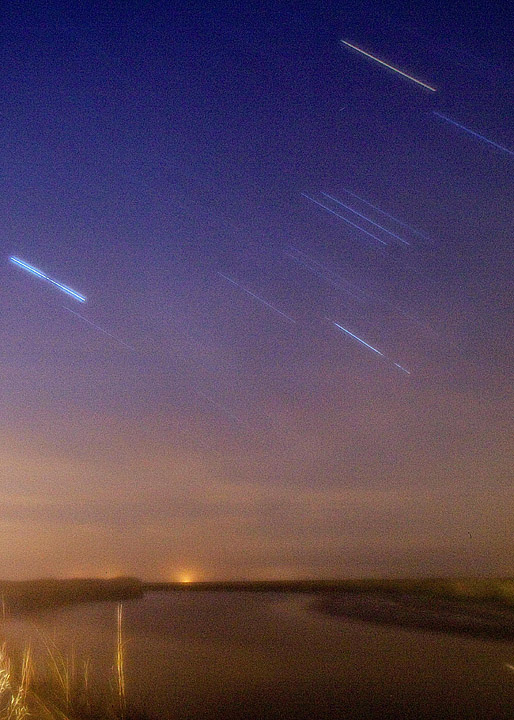
Neat shot with the meteors, but I'm afraid the noise is killing it. Welcome to NPN too.
Registered on April 10, 2005, 753 Posts, 21216 Comments
Comment posted by Pat Worley on November 20, 2009 at 11:03 AM
I see what you mean. I used the built in long exposure noise reduction in the Canon 50D. Do you have any other suggestions to remove the noise?
Registered on November 5, 2009, 1 Posts, 3 Comments
Comment posted by Joseph Rossbach on November 20, 2009 at 11:15 AM
Pat, the best way to reduce noise on a long exposure night-scape is to first of all shoot with a full frame sensor and secondly to shoot when the temperature is below 30 degrees. The larger pixels in a full frame sensor are not as densely packed as with a crop sensor camera and therefore do not produce as much noise. The other essential joint in the equation is to shoot when it is very cold. The heat produced by the batteries of the camera in conjunction with ambient temperature tend to heat up the sensor and cause excessive noise in an image. Shoot on a cold clear nigh and you will have much better results.
Hope this helps
Registered on November 25, 2005, 484 Posts, 1377 Comments
Comment posted by Dan Baumbach on November 20, 2009 at 12:08 PM
Interesting image. I don't mind the noise. Welcome to NPN.
- Dan.
Registered on November 1, 2003, 473 Posts, 7980 Comments
Comment posted by Joshua Hardin on November 20, 2009 at 12:10 PM
Joseph's suggestions are definitely good ones, especially for controlling noise in the shooting stage (which is the best time to do it). There are also software solutions such as the noise reduction filter in Photoshop or third party plugins such as Noise Ninja and Neat Image that you can use after the shoot. These require being slight with your adjustments though since heavy use of software can also decrease sharpness.
I'm curious about your camera settings on this one. Since the streaks are about equal in length, and seem to follow the same arc, I wonder if they are actually star trails rather than meteors.
Registered on July 29, 2006, 40 Posts, 414 Comments
Comment posted by Ian Plant on November 20, 2009 at 12:48 PM
These are definately star trails, not meteors (which usually don't record on the sensor unless they are very bright). As Joe said, cooler temps at night really help control noise (I find that temps below 60F are pretty good for exposures up to about 20 minutes or so, cooler temps really help with longer exposures). Also, try to shoot with as low of an ISO as you can. Most of my stars trail shots are done with ISO 400 or less.
Registered on July 7, 2008, 271 Posts, 1657 Comments
Comment posted by Grant Collier on November 20, 2009 at 1:05 PM
For star trails like this, I still shoot film, as it's hard to get low noise on long exposures with digital...lower ISOs help but the color noise really picks up the longer the exposure is. I picked up a film camera that is compatible with EOS lenses for about $20 bucks + $30 bucks for a cable release. As others have said, these are all star trails, not meteors. To capture meteors, you generally need to do short exposures on a digital camera of around 30 secs with a high ISO and the aperture wide open. The meteors are usually too faint and move too fast to be captured during long exposures like this.
Registered on July 29, 2005, 73 Posts, 430 Comments
Comment posted by Peter May on November 20, 2009 at 1:06 PM
These are star trails from the constellation Orion. You can see the three blueish stars in the belt and the red of Betelgeuse in the upper left of the group.
Registered on November 1, 2003, 7 Posts, 239 Comments
Comment posted by Dietrich Gloger on November 20, 2009 at 1:33 PM
I do like the noise here. It gives it a nice atmosphere. Colors are really appealing too. Welcome to the galleries!
Registered on January 26, 2007, 360 Posts, 9876 Comments
Comment posted by Ryan Shain on November 20, 2009 at 1:40 PM
Very cool idea, and the star trails a very nice up top. Enjoy the galleries here, and I see you have many good ideas coming your way. :)
Registered on February 20, 2007, 226 Posts, 4571 Comments
Comment posted by Pat Worley on November 20, 2009 at 2:29 PM
Hello and Thank You to Everyone for Your Comments,
I am overwhelmed by the response and the wonderful advice and information regarding this shot. I would like to give you more technical information and another image I shot prior taking this one.
The shot was taken approximately 5:45am, Nov 18 overlooking the Delaware Bay/River in S. Dennis Twp, NJ facing the SW sky. The temperature was approximately 48F. The photo was taken at f/9 29minutes 35 sec with long exposure noise reduction. ISO 400 Lens 11-18 @15mm. This is the right half of the shot. The meteors began to appear with frequency about 4;45am and ended as the sun started to come up. This shot was interrupted about 15 minutes into it by Duck Hunters who came with their headlights and headlamps, and of course their trailer and boat. The image is cropped because of the extraneous light from the hunters. I believe that the streaks were the meteors because I had taken an hour long exposure before the meteors appeared and it looked much different. The streaks were much more consistent. There were a couple of extremely bright meteors during this shot, so I had thought that is what I was seeing in the image. But as Ian and Joshua have both commented the arcs are consistent and the meteors definitely came across in different directions. I saw approximately 15 meteors in about 1hour and 15 minutes.
I have also included the shot taken at approximately 3:20 am at f/9 approximately 55 minutes with long exposure noise reduction. ISO 400 11-18@14mm. (You really don't take many shots with such long exposures) This shot was taken a bit higher in the sky with a light cloud covering in the beginning of the exposure.
Thank you again for all of your insightful advice.
Pat
Registered on November 5, 2009, 1 Posts, 3 Comments
Comment posted by Lon Overacker on November 20, 2009 at 7:34 PM
Pat,
First of all, welcome to NPN and the ES&S Gallery. We're glad to have you here and look forward to your participation.
I like the attempt here and I don't think I can add much to the technical discussion of the star trails, noise etc. I still use film and haven't attempted a star trail image in 10 or 15 years... :-(
Thanks for the followup information. It's really helpful when folks provide that extra info. I was going to comment about the light in the corner, and now it all makes sense about a car/truck driving by. Now, this is what it looks like, but nice to know what the source is.
Anyway, wish I could help you with the noise, but you can search the archives and articles here on NPN as there have been quite a few discussions on night photography.
Welcome aboard.
Lon
Registered on November 24, 2006, 521 Posts, 19147 Comments
Comment posted by Roman Kurywczak on November 21, 2009 at 1:37 PM
Hi Pat,
I have done plenty of digital star trail images....none in NJ as the light pollution can play havoc and really bring out noise. Defintiely lower the ISO to minimize that. The darker the sky....the more pronounced the trails and don't be shy about going to f4 or even wide open...trails will be more pronounced but avoiding ambient light is huge..
Registered on November 20, 2009, 56 Posts, 748 Comments

Comments
13 commentsHope this helps
- Dan.
I'm curious about your camera settings on this one. Since the streaks are about equal in length, and seem to follow the same arc, I wonder if they are actually star trails rather than meteors.
For more research on star photography, I recommend checking out this NPN article here: http://www.naturephotographers.net/articles0509/fv0509-1.html
Welcome to NPN.
I am overwhelmed by the response and the wonderful advice and information regarding this shot. I would like to give you more technical information and another image I shot prior taking this one.
The shot was taken approximately 5:45am, Nov 18 overlooking the Delaware Bay/River in S. Dennis Twp, NJ facing the SW sky. The temperature was approximately 48F. The photo was taken at f/9 29minutes 35 sec with long exposure noise reduction. ISO 400 Lens 11-18 @15mm. This is the right half of the shot. The meteors began to appear with frequency about 4;45am and ended as the sun started to come up. This shot was interrupted about 15 minutes into it by Duck Hunters who came with their headlights and headlamps, and of course their trailer and boat. The image is cropped because of the extraneous light from the hunters. I believe that the streaks were the meteors because I had taken an hour long exposure before the meteors appeared and it looked much different. The streaks were much more consistent. There were a couple of extremely bright meteors during this shot, so I had thought that is what I was seeing in the image. But as Ian and Joshua have both commented the arcs are consistent and the meteors definitely came across in different directions. I saw approximately 15 meteors in about 1hour and 15 minutes.
I have also included the shot taken at approximately 3:20 am at f/9 approximately 55 minutes with long exposure noise reduction. ISO 400 11-18@14mm. (You really don't take many shots with such long exposures) This shot was taken a bit higher in the sky with a light cloud covering in the beginning of the exposure.
Thank you again for all of your insightful advice.
Pat
First of all, welcome to NPN and the ES&S Gallery. We're glad to have you here and look forward to your participation.
I like the attempt here and I don't think I can add much to the technical discussion of the star trails, noise etc. I still use film and haven't attempted a star trail image in 10 or 15 years... :-(
Thanks for the followup information. It's really helpful when folks provide that extra info. I was going to comment about the light in the corner, and now it all makes sense about a car/truck driving by. Now, this is what it looks like, but nice to know what the source is.
Anyway, wish I could help you with the noise, but you can search the archives and articles here on NPN as there have been quite a few discussions on night photography.
Welcome aboard.
Lon
I have done plenty of digital star trail images....none in NJ as the light pollution can play havoc and really bring out noise. Defintiely lower the ISO to minimize that. The darker the sky....the more pronounced the trails and don't be shy about going to f4 or even wide open...trails will be more pronounced but avoiding ambient light is huge..