Lake Clark, AK
D300s
300mm
1/500 sec, f/8
Mode: Av
Metering: Spot
Exp comp: -1/3
ISO: 400
AF mode: AF-C
White balance: AUTO
Flash: Off
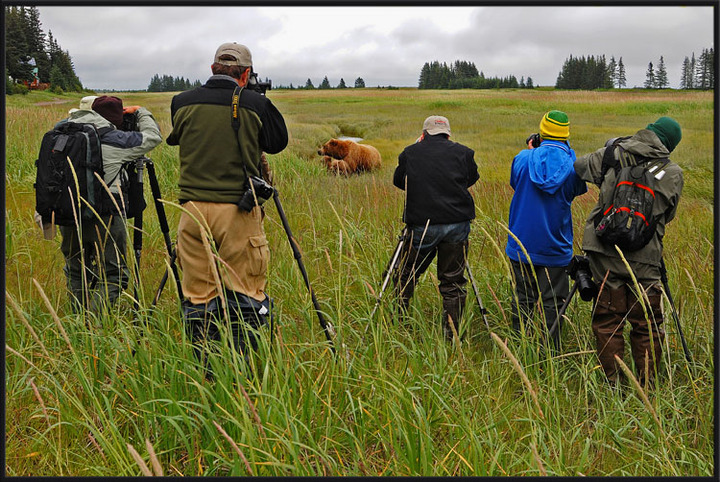
Before people squawk,

1. We were not as close as it appears
2. The bears are very acclimated in this well-protected place. Bears everywhere, but no bear "incidents" in more than 25 yrs here
3. The guy second from the left is a Ranger, who accompanied us everywhere for protection of both critters - the 4-legged, and the 2-legged kind. He strictly enforced "distance" laws
4. The bear clearly is not worried in the least
5. We were NOT AS CLOSE AS IT APPEARS!

Comments
12 commentsLast we were in a similar situation having as subjects some hermines: we were in one of our national parks, we had a park guide with us, and there were 10 photographers with big lenses ready to "shot" as one of the animals appeared on the door of the hole. But we have no shots of the situation!
Very well seen.
D&L
But seriously, the bears are so comfortable and non-threatened here, moms with cubs passed comfortably within 15 feet of us next to the lodges and cabins, if we were still.
Sandy
Bears in this well-protected NWR are safe, healthy, and live long lives and (obviously) breed happily and produce yearly twins or triplets most of the time. They don't do this if stressed.
The bears here also provide a safe environment for humans learning about bears, safe bear interaction, models for bear photos and paintings, and income for the park, the lodge owners, and the depressed area's and state's residents.
It's win-win, to me.
Sandy .
This level of "habituation" is within the normal relations of bears with other creatures (including humans) when they're on rich feed like salmon or spring grazing. Lots of other animals circulate in close proximity to the bears and feed on the same things. Everything has proven fine in over 20 years of this kind of viewing under close supervision and evaluation, just so long as the bears don't begin to recognize people as an easy source of food.
At the risk of "diluting" the impact of your great photo, I'm adding one of my own to illustrate the opposite circumstance. I took this shot with a 100mm lens as this sub-adult (400-450 pounds) charged an angler to steal his salmon. Even with the 100mm lens the hapless angler is just out of frame to the left. The poor bear, in his first summer without mom, isn't likely to survive long even if no one shoots him in "self defense." Because people have been so generous he has found no other way to catch his own salmon, yet any day now the anglers will quit for the year. Sad, but that's often the fate of fully habituated bears.
All the more reason I like yours!
At the place we stayed, one cardinal rule was, if you had a fish on (easy salmon fishing from the side of the stream) and a bear came in sight, we had to slack the line, drop the pole, and gather in a group further away. No sense tempting a bear always intersted in a splashing, hooked salmon.
In the time I was there, no bear ever tried to take a hooked salmon or approach us too close with a fish on. Probably because they were easily able to catch their own fish, and all the other food was very plentiful as well.
Sandy
Ken Archer