Feathers and Water
by Steve Balke
Mallard (Anas platyrhynchos platyrhynchos)
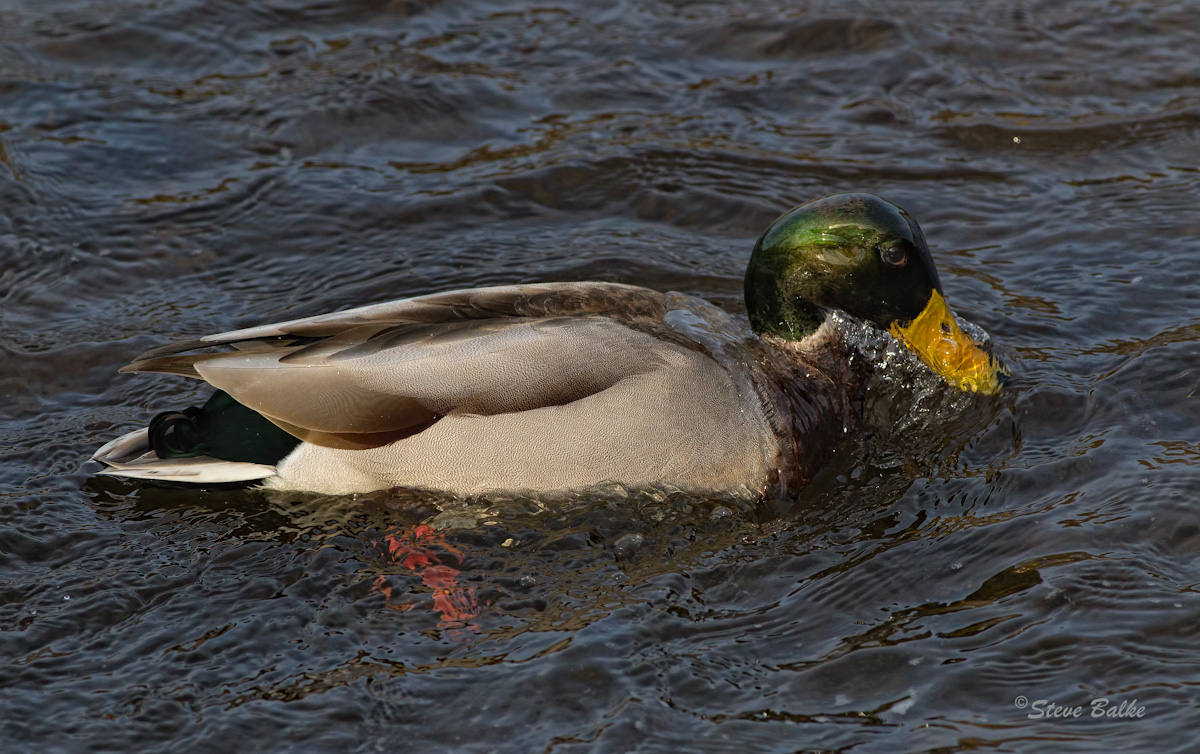
This image shows a mallard who has just brought up his head from being submerged. The small version is an extreme close up of a small portion of the bird (750 pixels x 590 pixels or only 0.4 MP) and was extracted from the large version (4399pixels x 2764 pixels or 12.2 MP).
i. Regarding the small version: I find that the fine patterns on this common bird are quite amazing. This lens and camera certainly can capture fine detail.
ii. Regarding the large version: I like how the water seems to be adhering to the head/neck area except in two (or possibly three) patches, including they eye: "Water off a duck's back" might be different than "water off a duck's head". The water isn't "beading up". Waterproofing originates from preening to spread "powderdowns" and oil from the preen gland. See:
http://www.birds.com/blog/waterproof-feathers-birds/
Maybe what we are seeing is the difficult-to-preen area being better "wet" by the water.
All comments welcome.
In a repeat of last year, I'll be away for the next couple of weeks on vacation in Grand Cayman beginning Dec. 12. I'm very much looking forward to another walk on the Mastic Trail. This time I have better camera equipment and will try to capture more images of the fascinating wildlife there. To be continued……
1D Mark IV, 400 mm f/5.6: ISO 1600, 1/2500 s, f/7.1, usual NR, exposure adjustment and sharpening.

Comments
8 commentsGreat post!
i. Without the high ISO I could not have used the 1/2500 ss to freeze the water flow. However, if I was only concerned about feather patterns then since this duck was not travelling that fast I would have been able to lower the ss and the ISO. I'm not sure how much influence this would have on the image quality. Post processing might have made up for the difference.
ii. If this image was taken at full frame then each feather characteristic would be represented by more pixels and therefore potentially show even more detail (assuming that there are finer structures to be seen at that level). However, it is a drastic crop from the large version image so the detail we see is that present in the large version. I think it's important to note that cutting out a small section from the large scale image and blowing it up (i.e. extreme cropping) did not affect the image detail present in the large version. For example, we don't see any smearing of the original detail.
Your comments are helping me to understand all of this more. Thank you all again.
I love how the water is running off of the duck in the larger version and the almost glassy appearance of the head. .
I love the pattern so well captured and composed in the smaller image and the water effect on the bird's head in the large version. Well done! Have a good trip!