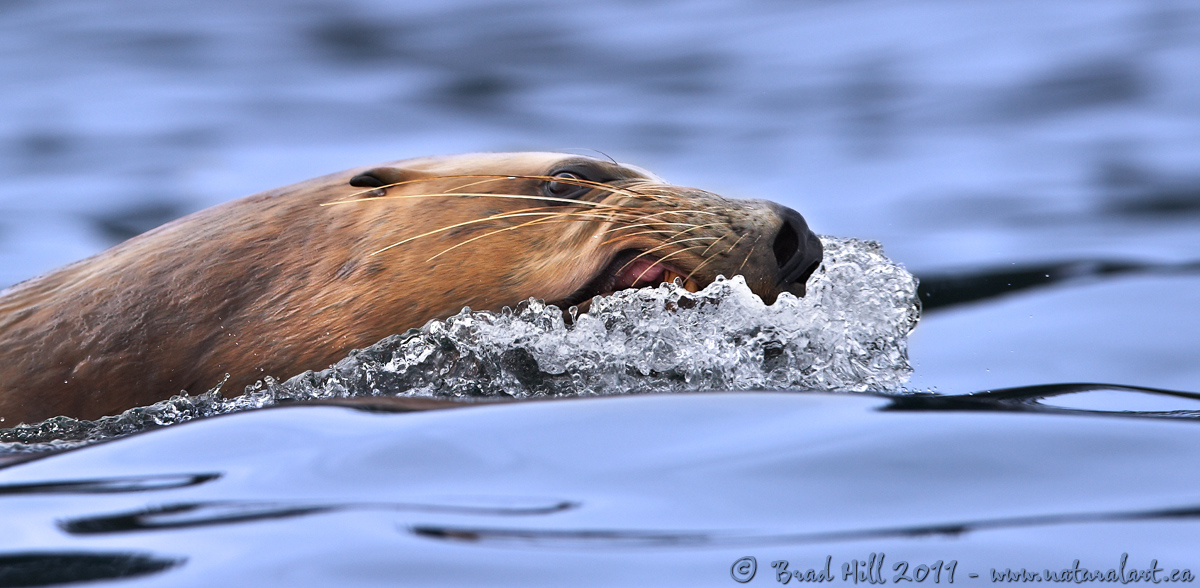
There are times when I use my camera simply to figure out what the heck an animal is doing. Usually these "documentary-style" shots are useful in that they teach me something about the subject, but they're rarely worth showing or have any other real value. This one happens to be a case where a documentary shot actually came out kinda cool...
During a photo safari in the summer of 2010 we encountered a large colony of Steller Sea Lions hauled out on rocks. While we were still hundreds of meters away a group of about 40 of them left the rocks and approached us. When they neared our inflatable boat they began checking us out. Several times one or more of them would raise their heads high above the surface and check us out in a way that made them look like periscopes. But most of the time you'd here a splash and, unless you just happened to be looking in the right place, see just the aftermath of a very fast "slicing" of the surface - a few ripples. And, even if you were looking at just the right place and saw a full "slicing" of the surface you'd swear the sea lion just skimmed the surface from below and never broke the surface. Each "slicing" took only fractions of a second. Of course, I wondered what the heck the sea lions were doing - so I decided to try to catch a "slice" in action in a photo in an effort to see what was going on. I figured the "slices" were of such short duration (and you saw so little of the sea lion) that they must be just trying to scare us away or something.
Well...here's one of the results: it's clear the sea lions were doing more than just trying to scare us off - the were using the high-speed maneuver to check us out - this guy is clearly eyeballing us (and throwing in what appears to be a snarl, just for good measure)! Mystery solved! And only because a LOT of modern imaging technology made it possible for me to capture this image - my eyes and slow reacting hominid visual processing system simply could NOT sort out what was going on (or even SEE the subject).
What factors contributed the most to helping me capture this image? Well, first off - a whole lot of luck. Any wildlife photographer who doesn't admit luck plays a role in a LOT of shots is being just a LITTLE disingenuous (to say the least). Second, a high frame rate AND a very low cost per exposure - let it suffice to say I won't show anyone the hundreds of blurry, out-of-focus messes that I shot before I captured this image (and nor would I have forked out the bucks for simple curiosity if I had to shoot several hundred FILM images just to get this shot). And last, but arguably most important, I needed to use a lens/camera combination with a lightning fast autofocus system. I DID prefocus in ABOUT the right place and waited for sea lions to "slice the surface" in the regions I was pre-focusing on, but the lens still had to adjust the focus some for virtually all the shots. One of the reasons you fork out the big bucks for professional quality super telephoto lenses is for super-fast autofocus - you don't always need it, but there are times when it's absolutely critical in getting the image you want/need. This was one of those instances...
Subject: Steller Sea Lion (
Eumetopias jubatus) checking me out!
Location:Northern tip of Vancouver Island), BC, Canada
Camera: Nikon D3s
Lens: Nikkor 400 mm f/2.8 VRII lens - handheld from Zodiac inflatable boat. VR on and in "Normal" mode. Circular polarizer used.
Exposure: 1/1600s at f4. ISO 250. +0.33 stop compensation from matrix metered exposure.
Crop: This is about 80% of full frame horizontally, more cropped to pano orientation from top & bottom.
All the contextual information surrounding this shot (field notes, all camera settings and processing details, conservation, etc.) can be found at:
http://www.naturalart.ca/galleries/latest/.
Comments and feedback greatly appreciated...probably better to view larger version prior to doing so...
Cheers...
Brad

Comments
15 commentsI'm enjoying this image as much as I've enjoyed reading the story line, your thoughts and opinions, which is to say, a lot! :^)
The low angle and eye contact you acquired is simply marvelous, and the turbulent water the Sea Lion is throwing up frozen in motion is simply wonderful :^)
If there's one message in all you wrote that I hope will stick with me more than anything else, it's the constant reminder I need to not be so gun-shy when it comes to holding down the shutter release and firing off multiple frames.
Lord only knows how many excellent photo opportunities I've probably missed due to my instinctual nature to lift my finger off the shutter release after I hear only two or three clicks, when I could easily have fired off 10-15 or even more.
Perhaps this instinct was learned from my days in the army that stuck with me from all those years ago, where we were trained to fire off only short bursts when on fully automatic, who knows. But it's something I'm determined to shake off, as moments with wildlife frozen in action portray for me probably the most visually stunning and captivating images of all, and this is exactly the type of imagery I wish to create.
Many thanks for showing us this Brad as well as sharing your thoughts, and for inspiring me all the more :^)
Kind regards,
Ashley
Just one small thing; on my monitor the water looks a bit on the off (i.e. a slight magenta cast), but perhaps it is time for a re-calibration of my screen.
One remark that struck me about Ashley's comment was this:
I am not sure if she got your message right as you are normally not one that advocates 'machine-gunning' shooting behaviour, or am I wrong.
I don't see the magenta on my monitor - but it's been awhile since I re-calibrated it so it might be MY monitor that's "wrong" - not yours!!
RE: the "machine gunning". I have commented on this in the past, and I have no problem with it during action sequences. Where I wonder more about the merits of machine-gunning is when it's done on a more static scene with the thinking of "well, at least one will be sharp" (and I HAVE seen this a number of times). To me it has the potential to lead to sloppy shooting both technically AND compositionally.
And I'm REAL glad you like the image - thanks!
Cheers...
Brad
Edwin
A unique and likely once-in-a-lifetime image. The angle of the head, the frozen action of the water and that subtle snarl are just stunning. Machine gunning has its place and the AF system of that lens/camera combo is deadly to capture this and get even the eye sharp with a whisker crossing in front of it.
While I'm also of the opinion that so called "machine-gunning" shouldn't become a habitual practice, for the precise reasons Brad offered, there are certain situations where I'm sure it's the best - if not the only - way to increase one's chances of securing the shot one's looking for. For me right now though, I surely need as much practice with "machine-gunning" technique so that I'm ready whenever Nature throws up a perfect opportunity ;^)
Oh and BTW Vincent, although I take this as a compliment, as I've always felt I'm very much in touch with my feminine side and, if my wife's anything to go by, women are generally far more intelligent than men, I'm not actually a "she" ... for better or worse I'm a "he" - LOL ;^p
Wishing you both a great one ahead :^)
Ashley
Thank you very much for your original comment and I have to say that this last one made me roar with laughter! I wish I could see Vincent's face when he reads the comment - I'm guessing he'll be red as a beet while smiling away! Well handled!!
Cheers...
Brad
I was actually chuckling to myself as I typed out that little piece of personal info to Vincent while wondering what his reaction might be - LOL ;^p
Hope he sees the lighter side as we did and doesn't feel in any way embarrassed ... and Vincent, if you happen to read this, if it makes you feel any better, you're certainly not the first to mistake my gender if only by my style of writing, or at least I think it's only my style of writing - LOL ;^)
All the best :^)
Ashley
Ken Archer