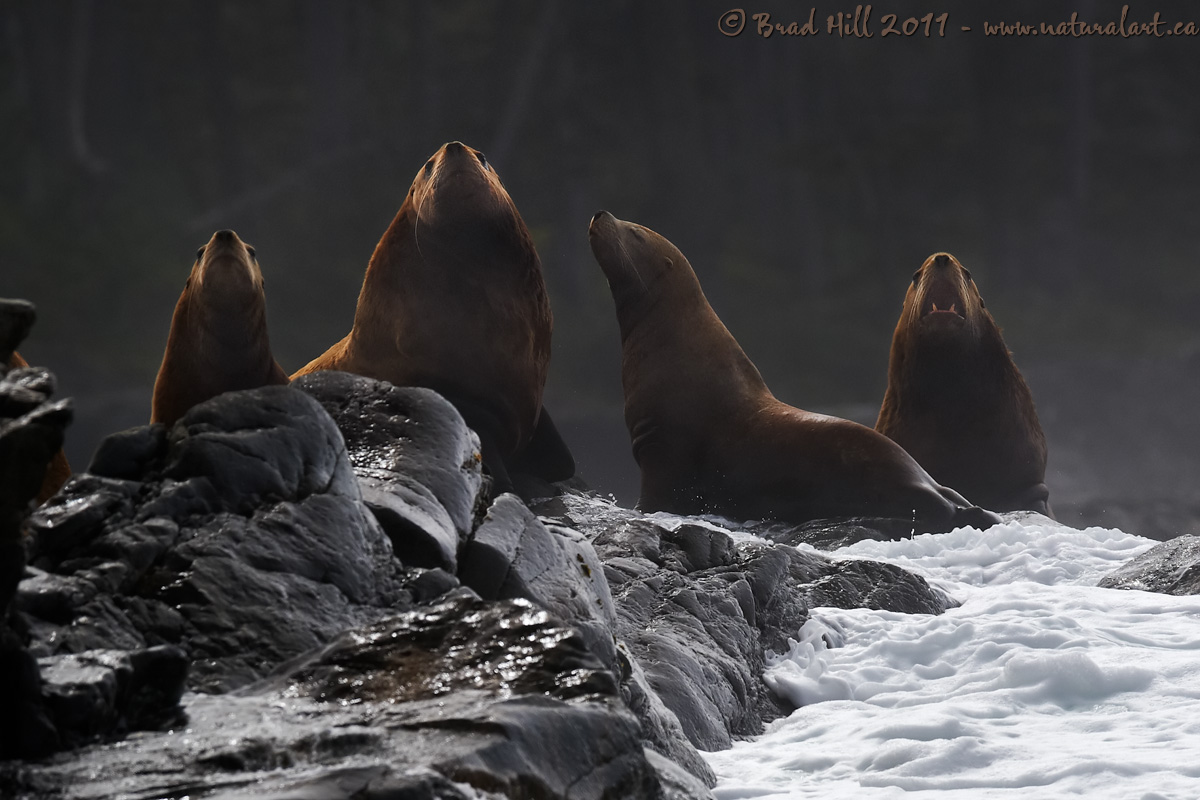
The Steller's Quartet
I post this image knowing it likely won't have widespread appeal and it may even be a bit of a love it or hate it (or maybe dislike it or hate it!) type of image. It's certainly a bit of a monitor-tester!
During an aquatic mammals photo tour in late summer of 2011 we had the opportunity to spend some time with and photograph a large "colony" of Steller Sea Lions. This particular group of sea lions is in a very tough-to-access location - they're in waters that are typically very "active" with both large swells and chop and the area is quite remote. But, after working with these lions for two years in a row I can say this - Steller Sea Lions are DEFINITELY under-rated as a photographic subject! And, besides loving the physical and photographic challenges of working with these fascinating mammals in this particular location, the thing I like most about photographing sea lions is the continuous, diverse, and fascinating social interactions that are always taking place - in a single scene/frame you'll often see two or more lions bellowing at one another, mothers suckling pups, dominant males displaying, and more.
Several things about this scene appealed to me. I liked the almost "classic" sea lion pose of uplifted head with closed eyes that 3 of 4 of the subjects are exhibiting (and that is best displayed by seal that is sitting broadside), how the sea spray helped separate the subjects from the background, and how the mist in the air (from the crashing waves) helped to slightly diffuse and soften the sunlight. And, of course, it wasn't lost on me that the four lions almost looked like a quartet of singers belting out some woeful tunes (and it's obvious the guy on the right is the lead singer!). I DO wish that the out-of-focus rock in the lower right wasn't there (or was closer to the subjects)...but I guess ya gotta work with what you're given!

One of the things I like the most about modern digital photography is that if you're prepared to do a little post-processing work you're able to capture images in situations where a few years back (using either film or early generation digital cameras) it would have been absolutely impossible. This shot is a perfect example of that. I shot this at almost high-noon on a clear day. Between the harsh top-lighting and the wet rocks (and white-white surf rolling up the rocks) the lighting was INCREDIBLY harsh and contrasty (to say the least). There WAS some sea-spray/mist in the air that softened the light a tad, but the scene was a mix of super-bright and super-dark zones (and well beyond what even the dynamic range of my eye could see). To kill some of the glare I used a circular polarizing filter. But I knew that this shot was one of those ones where there was absolutely no choice but to approach it from a "shoot-to-process" perspective (i.e., that there was NO WAY it could be captured "right" in-camera). So, I exposed the image to JUST retain the highlights in the water and on the sea lion's top-side. Which meant that the bulk of the original raw capture was dark, dark, dark! And, that meant that MOST of the post-processing work on this image dealt with balancing out the exposure and drawing subtle detail out of the shadows.
Could this image - as presented - have been captured in-camera in JPEG format or been produced by someone who shoots raw but doesn't like to do much processing work? Well...with current camera technology - I don't think so. While I respect "purists" who don't like the concept or philosophy of doing much (or any) post-processing work, until cameras are "perfect" or beyond (in recording scenes as we see them or "see" an even wider dynamic range than our eyes do) there are many situations where they will encounter scenes - including very visually interesting ones - that they'll just have to walk away from...
Subject: Steller Sea Lions (
Eumetopias jubatus) on haul-out rock
Location:Northern tip of Vancouver Island), BC, Canada
Camera: Nikon D3s
Lens: Nikkor 400 mm f/2.8 VRII lens - handheld from Zodiac inflatable boat. VR on and in "Normal" mode. Circular polarizer used.
Exposure: 1/2500s at f5. ISO 560. -0.67 stop compensation from matrix metered exposure.
Crop: This is about 80% of full frame image
All the contextual information surrounding this shot (field notes, all camera settings and processing details, conservation, etc.) can be found at:
http://www.naturalart.ca/galleries/latest/.
Comments and feedback greatly appreciated...probably better to view larger version prior to doing so...
Cheers...
Brad

Comments
12 commentsPeter
The white surf, their poses and the apparent golden light are all awesome. Sure, this isn't as good in comparison to most of your work in terms of detail and depth of focus(even on the sealions). Still the composition and the subjects themselves are compelling enough to pull it through.
I guess the take home message is that with a carefully chosen exposure and proper processing we can recover important details in difficult situations like this. Especially if its to document rare/interesting subjects/behaviour.
In terms of impact, should be interesting to compare it with dark exposure as it is without trying to recover the details. It might accentuate the shapes of top lit sealions.
You managed very well with the exposure, as well as the processing. It would have been impossible with film or in camera jpeg. I feel that snow on the right side, interferes with the otherwise dark mood of the frame. It may appeal better, if you go more pano, eliminating more snow area.
Jagdeep Rajput
PS.Thanks for correcting me.
That's not snow, that's frothing water. I think it adds to the "saltiness" of the scene and its inclusion helps portray the tough environment in which these creatures exist, but could be wrong!
Cheers...
Brad
I really like the soft colors and yet the powerful rocks and waves.
Never seen them, but think you are right that they make perfect subjects to observe and photograph.
It looks like a real challenge to get a sharp image sitting in a rocking Zodiac.
I can see why you find the rock in the lower right a bit disturbing, but it is not big deal for me. (you could have cloned it out, but glad that this seems beyond what you think is acceptable in post processing ...) Personally I find the hidden Sea Lion in the rocks on the left a bigger point. Not sure whether cropping him and the rocks would improve the already stunning image.
For somebody who is always altering images we would not accept anything less than such a well balanced frame, even considering the given circumstances. ;-)
Thx fr sharing image and shooting and post processing details.
Jef
Thanks for the feedback...
Jeffry - you said: "For somebody who is always altering images we would not accept anything less than such a well balanced frame, even considering the given circumstances. ;-) "
Interesting choice of words! Yep, guilty as charged - I regularly adjust the exposure of my images (tho' as you point out don't use the clone tool or any other means of adding or removing elements from my images). So feel free to put me in the same category as those evil guys who used that super-saturated Velvia film, or split ND filters, or had the audacity to under- or over-expose their images in the field (and I heard a rumour that SOME even manipulate their images by softening the background by choosing a wide aperture or unnaturally blur them by selecting a slow shutter speed!!).
All tongue-in-cheek but my point is that NO images are "un-altered" from the original scene - the very act of selecting anything but a 52mm lens means we've changed perspective, magnification, etc. It's easy to use loaded terms (like "image manipulation" or "altered images") to make it seem like some changes are OK and others cross the line, but it really is hard to actually draw a firm (and unchanging) line between what is and isn't acceptable in image alteration. To me the line that says "in-camera alteration is OK" and "post-processing is bad" carries no logic whatsoever, especially as more and more post-processing is "loaded" into the new cameras (heck, I noticed yesterday that my iPhone does HDR in-camera!!). In the end, to me it's all about disclosure and not mis-representing what you've done to an image...
But thanks for your feedback and referring to this "corrected" image as a "Great image with a fairy-tale mood..."!!
Cheers...
Brad