October
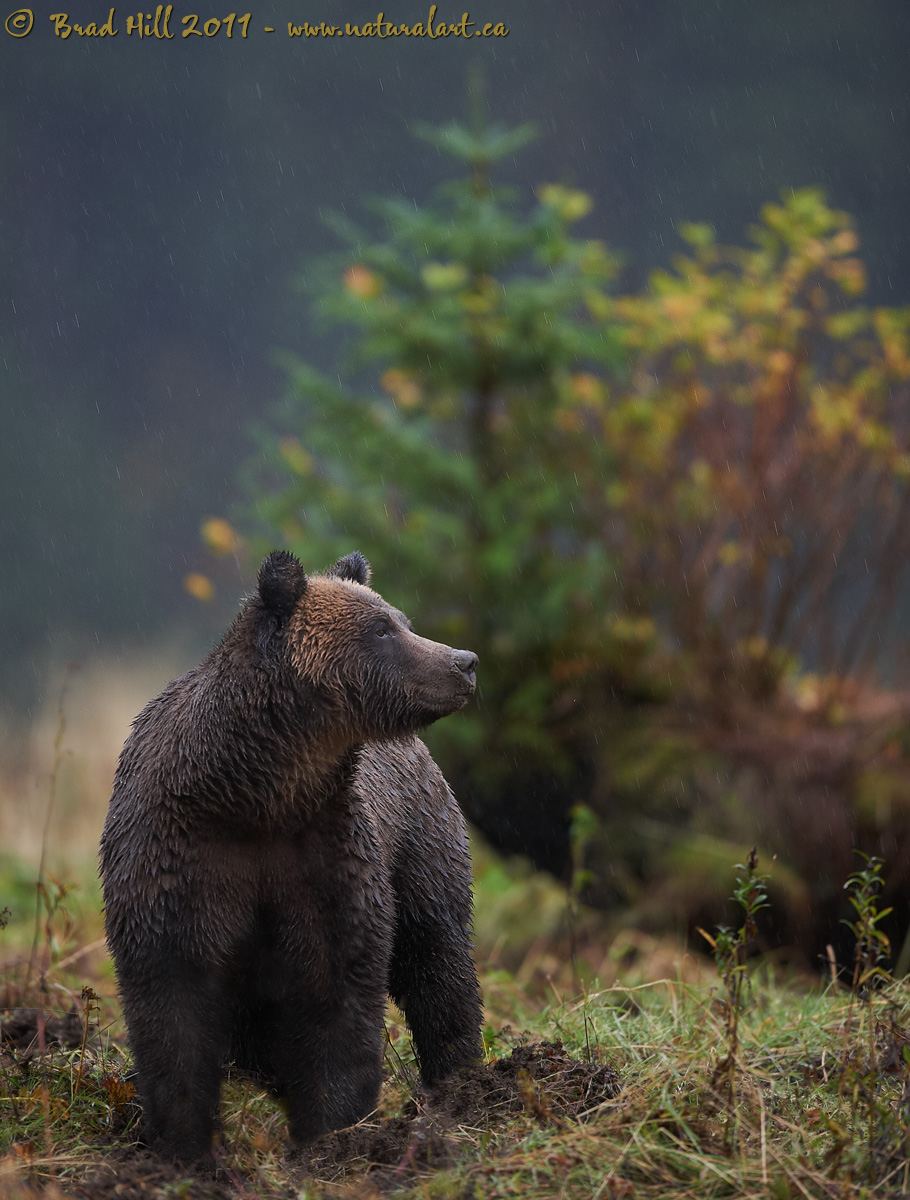
October in the Great Bear Rainforest brings rain (best seen in the larger version of the image), spectacular fall colours, and creatures preparing for a foreboding winter season. In most drainages the autumn salmon run is nearing completion and grizzly bears begin supplementing their sky-high caloric demands by digging up and eating large quantities of nutritious roots. This grizzly took a few seconds out from digging to survey its surroundings and ensure it was safe for both her and her cub to be exposed in open terrain. Her cub showed complete trust in its mother's abilities - over a period of several hours it dug up roots with almost never raising its head! Good for the efficiency of root collection and consumption - but bad for photographers!
One of my favourite "tools" to capture wildlife photos is a 400mm f2.8 super-telephoto lens. Many wildlife shooters opt for the lighter and slightly "longer" 500mm f4 lens (or the 600mm f4), but between the sharpness of the 400mm lens and its super-wide aperture, it provides a wildlife photographer with an almost unmatched ability to separate a subject from its background. This image is a good example of what I mean - I definitely wanted to include both the small evergreen and the yellow-leafed bush in the image (to provide the viewer with both a sense of place AND time). But, I wanted the bear to "pop" away from the potentially distracting elements - both to focus the viewer's eye on the bear and to create depth and almost a 3D look to the image. So...I cranked the aperture wide open (to f2.8) and simply waited for the bear to look up and to its left (with, of course, the trees positioned mostly behind the bear and to the right side of the frame for visual balance in the scene).
Every image captured involves an "optimization" process (in terms of balancing shutter speed, ISO, and aperture to satisfy both technical constraints and the photographer's creative goals) and some compromising. Personally I tend not to like out-of-focus foregrounds, especially if the foreground is somewhat "chaotic" (like this one is). Because I was shooting wide open here it meant I had a very shallow depth-of-field - that allowed me to separate the background the way I wanted but provided me with a VERY thin band of in-focus foreground. To avoid having a visually distracting, out-of-focus foreground I placed the bear very close to the bottom of the frame (essentially at the "front" of the frame). Some may dislike how close this places the feet to the bottom of the frame (yes, the "virtual feet" ARE in the frame!), but placing them there was a compromise I was aware of and am prepared to accept (to prevent the image from having a distracting out-of-focus foreground). Compromises...
Subject: Female Grizzly (
Urus arctos) surveying the terrain on an October morning
Location: Great Bear Rainforest, BC, Canada
Camera: Nikon D3s
Lens: Nikkor 400mm f/2.8 VRII lens - supported on carbon fibre Gitzo 1348 tripod with Wimberley head. VR on and in "Normal" mode.
Exposure: 1/250s at f2.8. ISO 800. -0.33 stop compensation from matrix metered exposure.
Crop: Very minor - this is about 90% of full-frame image
Alert - Digitally Manipulated Image: This image clearly crosses the line from simple digital correction to digital manipulation. In the case of this image, I digitally removed (using the clone tool) one stem of grass that overlapped the bear's lower left leg.
All the gory details about this shot (processing details, conservation, etc.)
http://www.naturalart.ca/galleries/latest/.
Comments and critiques welcomed - probably best to view the larger version prior to doing so!
Cheers...thanks for looking...
Brad

Comments
15 commentsYou asked "...what did you use to keep your equipment dry?".
For cameras "in the hand" I use rain covers from AquaTech - I've been using these for a number of years and have been very happy with them. Several of the other participants on the trip used rain covers from Think Tank Photo and they appeared to work very well too. The AquaTech's and the rain covers from Think Tank are priced quite similarly. On this trip I also took along a "Rain Coat Pro" from LensCoat. It is a slightly lower-priced unit and has the advantage of not requiring a dedicated "special" eyepiece to use (like the ones from AquaTech and Think Tank do) - so it can easily be swapped between cameras. The rain covers from AquaTech and Think Tank offered slightly better protection in very stormy (monsoon-like!) conditions, but in most situations the RainCoat Pro would be MORE than adequate.
For "other gear" in the field I usually use a backpack-style cover (e.g., the ones from LowePro or F-Stop) and the critical thing is to get their dedicated rain covers on BEFORE it starts raining!
About the "darkness" of the image: I agree it's dark, but I chose to show the scene as it was - very dark and with subdued lighting...
Hope this helps...cheers...
Brad
Ron Huff
Ken Archer
great shot...
does not look dark at all on my screen...
I like the rain,
very nice, tough capture...
and thanks for the gear suggestions...
Felt a little uneasy about the placement of the bear, but the moment i openend the large version, my eyes never ventured anywhere near the feet.
A minor detail, some in-focus grass blades seem to have picked up a lot of sharpening on the lower right.
Thanks for the feedback. Some specific responses:
1. Bill: You said: "By using another Stop (F4) maybe more foreground would have worked ? Also by using your 200-400 Vr Lens & backed off slightly to say about 380mm length would probably achieved these results."
Good idea on trying a f4 aperture setting. And, I did that. But in doing so the background trees/bushes were just a tad more in focus and the bear was not quite as well separated from the background and, to be perfectly honest, the image didn't work nearly as well (for me). Oh...and I no longer own a 200-400 (it's now in the hands of a very fine young photographer who regularly posts on NPN!), so that wasn't an option...
RE: the amount of foreground and how close the bear's feet are to the bottom of the frame. I totally expected that some would point this out - this was the compromise I was referring to in the original commentary. In my opinion adding additional out-of-focus foreground added nothing to the image and was (to my eyes) a distraction. I totally accept that others disagree and have stated this in their comments - this IS (after all) a CRITIQUING gallery where we all (myself included) point out perceived "flaws" in the work of the posted images. But I think it's important to realize (and I'm mainly saying this for the newer and less experienced members who often try to accommodate ALL feedback, even if it's conflicting feedback) that...
1. At the end of the day MOST of us are really shooting to please ourselves, and...
2. The general public would almost NEVER notice the things we tend to nit-pick in the NPN galleries. In the case of this image, I think Anand said it well when he said "Felt a little uneasy about the placement of the bear, but the moment i openend the large version, my eyes never ventured anywhere near the feet."
As a further illustration of this last point - it's always refreshing to me to pick up a copy of National Geographic magazine and flip through the images. The bar on NPN has got so high (and this is a great thing!) that if the images from Nat Geo were posted in here, most would be absolutely skewered!!
My intent in posting this image was to draw attention to the compromises and trade-offs we are forced to make when capturing images in a field setting and generate a little discussion about that - so I think it's safe to say (thanks mainly to the feedback posted above) "mission accomplished!".
Thanks all!
Brad
What I've learned to do though is to to make a practice of looking at an image first and foremost to simply pick out the aspects that I find immediately appealing - in this case, the thoughtful pose of the Bear, the falling drops of rain, and the darkened lighting that seems to fit the scene at the time perfectly - and only then do I allow my critical mind to pick things out if it really has to ;^)
In summary of this one: I like it very much Brad, and would be extremely proud to have it in my collection as one I'd taken myself :^)