Wild Horse Wading
by Bob Decker
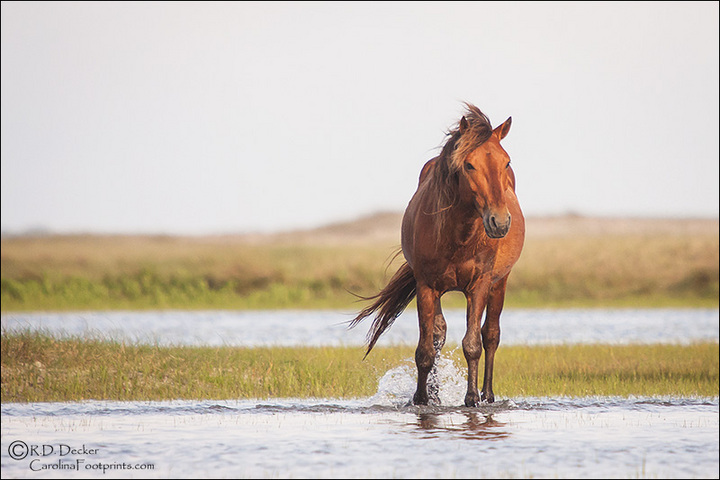
A wild horse wades across the flooding tidal flats of the Rachel Carson Estuarine Reserve near Beaufort, NC. Horses have been living wild and free on the barrier islands along the North Carolina coast for nearly 500 years. While the animals living in the reserve have a shorter history the herd's origins included "Core Banks Ponies"... Colonial Spanish Mustangs... intermixed with domestic breeds. Abandoned when their owner passed away in the 1940's the descendants of these horses have occupied the islands making up the reserve ever since. Today they are protected by the state as a cultural resource.
Canon 40D
Sigma 50-500mm @ 500mm
f/8.0
1/1250
+.67
iso 800

Comments
10 comments(Hopefully I haven't contravened any copyright rules by referencing Mr. Bateman's painting?)
Thanks for the comments, Gary. Much appreciated. The painting you referenced is a little bit of a different situation. In the painting the coyote's body is also angled in the direction it is looking. It's still an interesting and enjoyable image. I can only presume that the artist is trying to create a bit of drama... make the viewer wonder what the "dog" is looking at out of the frame. Compositional choices often depend on the story the artist wants to tell.
I like this just as it is, colours and pose are perfect for me. I find it so strange that there are so many wild horses all over the world, (southern Namibia springs to mind) who were just left and have reverted to how they once lived, wonderful thing nature
Ken, in the USA horses, particularly wild horses, are associated with the western parts of the country and with cowboys. This mental association is so strong that people are often surprised to find out there are herds of wild horses living along the eastern coast of the continent. I find the story of the horse's return to the Americas an interesting tale. The horse originated here,spread to "the old world," then went extinct in the Americas about 12,000 years ago. Then as Europeans began to explore and settle the Americas the horse was reintroduced to its continent of origin.
This is an interesting capture to analyze. Note the eyes are perfectly placed on the intersection of thirds (another "rule") and consider if the tail were swaying the other way he would probably feel unbalanced in the frame, but here diagonal pulls it back. If one were looking for an image "of a wild horse" a vertical format would present him nicely, but here the environment is a strong sense of place and the image becomes one of "place" with a gorgeous wild horse as its accent. Thanks for sharing it!
Sandy