
by Brad Hill
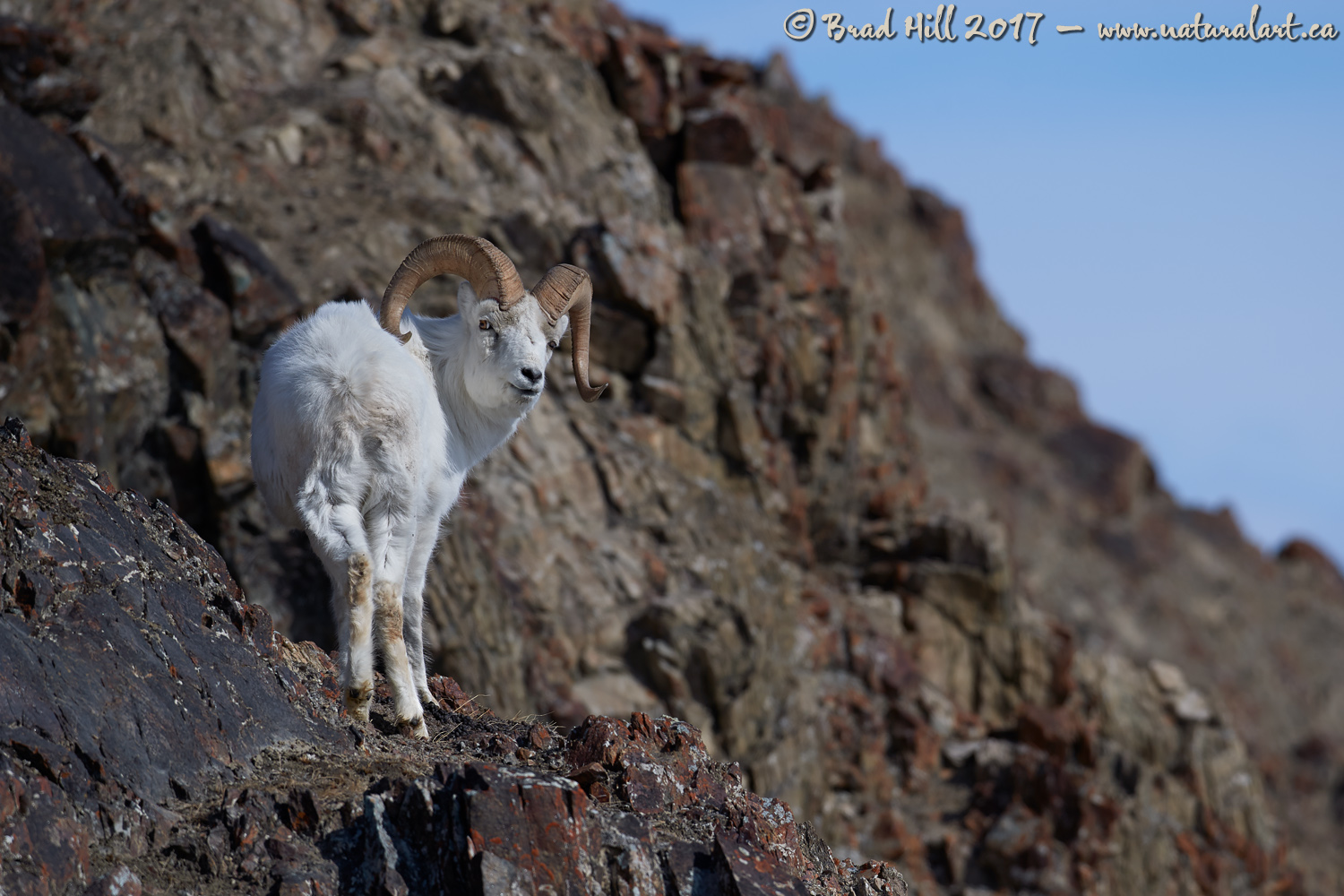
I captured this image of a Dall Sheep ram on April Fool's Day in 2017 - and now I'm wondering as I write this if his "I dare you to follow me" look was his idea of an April Fool's joke directed at me! If you ever want to feel inferior and clumsy just try to follow a mountain sheep (or, for that matter, a mountain goat) across a steep, rocky mountain side! It's humbling, to say the least...
One of those most difficult things to do when teaching wildlife photography is to get the "trainee" to pay attention to multiple things at once when working with an attention-grabbing subject. It's easy to pay attention to your subject. It's harder to split that attention between your subject and everything else in the frame. And, it's even harder to pay attention to your subject, everything else in the frame, AND how the scene will look when something even harder to really see through viewfinder (the DoF and out-of-focus zones) interact to form your final image!
I'm a stickler for how out-of-focus zones are used in an image. Throwing a background out-of-focus by choosing the correct aperture can help guide the viewer's eye to the subject. But...if there are multiple out-of-focus zones in an image (which normally means out-focus-foreground, in-focus subject, and out-of-focus background) it can look too artificial and the out-of-focus foreground objects can be quite distracting. This is especially true if the foreground contains irregular objects, like rocks. In most cases I strive to have a single transition from in-focus to out-of-focus zones in an image (as demonstrated in this image). It's something that's easy to discuss and point out, but can be incredibly tough to pull off in a field situation, especially when using super-telephoto lenses. You have to know your DoF (for the lens in use), pick exactly the right aperture to shoot the image at...and position your subject within the frame very carefully. Of course, if ALL you're paying attention to is your subject (and not thinking on a couple more levels!) then you'll have to count on having a lot of luck in getting the in-focus and out-of-focus zone relationships right! ;-)
Oh...and my answer to the question in the image title? Sorry Mr. Ram, I'm not even going to TRY to follow you (and you can call me a chicken!).
Subject: Male Dall Sheep (Ovis dalli) taunting a clumsy photographer
Location: Southwest Yukon Territory, Canada
Camera: Nikon D5
Lens: Sigma 500mm f4 Sport lens. Supported on Really Right Stuff TVC-24 tripod with an Acratech Long Lens Head. OS on and in “OS1” mode.
Exposure: 1/1000s @ f5.6; ISO 100. No compensation from matrix-metered exposure setting.
Crop: Extremely minor - this is about 95% of full frame
A whole lot more info about this shot - including a 2400 pixel version it - can be found on my website using the link immediately below.
http://www.naturalart.ca/galleries/latest/detail_2.html
Comments and critiques welcomed - probably best to view the larger version prior to doing so!
Cheers...
Brad
PS: Like all wildlife images on my website and that I post on NPN, the subject is fully wild and completely unconstrained. Besides the potential impact of my presence, nothing has been done to intentionally alter or affect the ongoing behavior of the subject and, of course, there has been no use of any form of bait or other form of wildlife attractants (including vocalizations).
Comments
3 commentsDall Sheep appears to be very concerned about the F stop.
BTW your choice of DOF setting is spot on.
Jagdeep Rajput